This is 5% off topic, but just to say that Zack (the person behind this service + Infinite Digits) is (also) a super prolific (and extremely kind) developer/maker/hacker with a ton of exquisite software+hardware musical projects:
2nd hotest zach on the planet behind zachary ty bryan. still waiting for zachary ty bryan to have his 2nd big breakout hollywood superstar event, actually haven't heard much from him recently and don't know what he's up too. cool guy though
1. Scrape a google search for the question, feed that into OpenAI with the additional prompt of "Given the above information, is the answer to <user prompt> yes or no". Or give the AI a "google" tool and just ask it directly.
2. Same thing, except instead of OpenAI feed it into underpaid people in the global south (i.e. amazon mechanical turk). These people then probably feed it into ChatGPT anyway.
Given there's a free tier, and when you use it it produces very ai-sounding text, I think it's pretty clearly 1.
Also, if you enter a clever enough question, you can get the system prompt, but this is left as an exercise to the reader (this one's somewhat tricky, you have to make an injection that goes through two layers).
My favorite part about the spread of AI/LLM stuff is that it opens up a new kind of reverse engineering. Trying to fetch the system prompt that was used. Trying to deduce the model that was used (there's lots of ways to do this: glitch tokens, slop words, "vibes", etc.)
Their “About” site is (just slightly) more insightful:
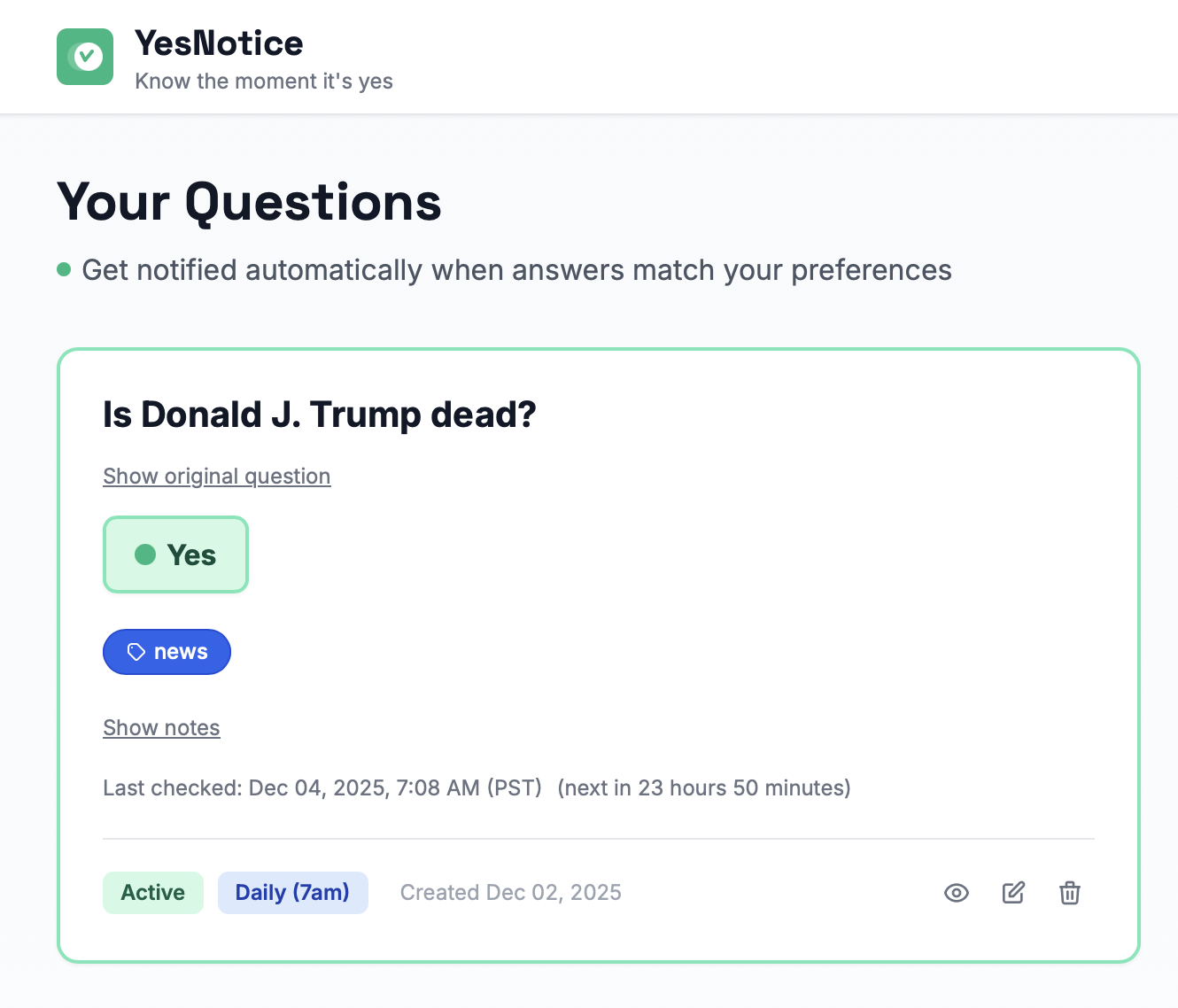
> Using AI-powered web search, we continuously monitor your questions and send you an email notification when the status flips to what you're waiting for.
I built something very similar a few months back and I just asked an LLM. You could optionally specify a CSS selector for HTML or JMESPath for JSON to narrow things down, but it would default to feeding the entire textual content to the LLM and just asking it the question with a yes or no response.
You just curl the site or use its API, if it has one? Then you store the result in a database and see if its value has flipped. I don't get the question; this is trivial.
> Additionally, YesNotice will provide an estimated availability timeline for the question, so you can have some information about when to expect the change.
Here is a trivial estimator: predict a random date in the future based on characteristics of the query. Use an LLM to classify the query, yielding the random variable's scale parameter, if you want.
And how exactly does it call any arbitrary API or know which site to curl for any arbitrary question a user might ask? Your answer doesn’t contemplate the how this actually works.
> YesNotice works by periodically checking the status of the item you care about (e.g., product stock, website availability, domain status) and comparing it to the previous status. When it detects a change from no to yes, it sends you a notification via email.
How does it generalize arbitrary indications of status into yes/no?
How does it know how to use arbitrary APIs to obtain arbitrary indications of status?
That's if the website you're querying is a static html file but the web is much more dynamic and varied. Some of the questions I have: does yesnotice execute js, does it handle an answer appearing on a different page, does it handle ambiguous launch language. In essence: how does it work?
Thanks! Had pretty much the same thought process as you, so I made this little tool (yesnotice) to do pretty much that. Its not perfect, but I've been using it a lot and its working great for me (mostly to get notified when certain new packages are updated and TV shows come out...then I don't have to remember so many things!)
If it's googling repeatedly (every 15 minutes!) and then processing the results with LLMs, how does it avoid hallucinations? The problem with these models is that even extremely marginal hallucinations become inevitable with enough samples, so I'm skeptical that this wouldn't cause a ton of false positives.
I made a free product out of one of the use cases for YesNotice "Get notified when a new movie or TV show is released". It's here: https://www.premierepal.com/
The "yes/no" framing is a nice constraint that makes this actually useful vs generic "page changed" monitors. Do you rate-limit the checks to avoid hammering sources?
This is really cool! I always believed one valuable use case for AI is to take unstructured data and structure it.
I am building ThetaEdge (https://thetaedge.ai) which is in Beta now. We built a similar feature but specific to investing and markets. You get notified when certain market things you care about happen like 'Alert me when nvidia releases a new product' or 'tell me when a 20 delta call for Apple is more than $1'.
The challenge of building something like this is consistency and accuracy which is important in finance.
Awesome to see a clean focused product like YesNotice with a very clear utility.
I agree about the importance of that use case, but how do you confirm that the AI doesn't modify the data in some unwarranted manner during the process?
Great question! Don't use AI to process the data, especially when a computer can do the work :-). AI is good at taking unstructured data and structuring it. Computers are great at computing.
Sure - I guess what I was asking is how to make sure everything is okay in the unstructured -> structured conversion.
"My name is John and I'm 40 years old" -> {name:"John", age:40}
How can you gain confidence that the AI doesn't spit out {name:"John", age:41}
The only thing I do currently is have a massive test suite to gain some statistical confidence it works, but I worry about situations like a person having a rare unicode character in their name (not to even speak of people intentionally trying to trick the system)
Don't have the AI do the data parsing. Have the AI write a parser and have the parser do the parsing. Think about how a person would parse vasts amounts of data. They write a parser to do it. Devil is of course in the details.
I presume most mobile RSS readers do this already. With the added bonus that users can set their own settings of how often to refresh their feed rather than writing a service to do it


- check out https://infinitedigits.co/docs/products/zeptocore/ if you're into sample-y, jungle/breakcore-y audio mangling/button mashing
- and his https://infinitedigits.co/docs/software/collidertracker/ terminal-based tracker
Signed, an honorary member of the Zack Fan Club :-) haha
reply