Prior to the current administration there's been a ratcheting up of political influence / social engineering on science grants as well. The last DoE Office of Science grant I applied to had a DEI requirement that was also used during screening. My preference would all this political influence be dialed down.
Did it have a claw back clause? If not, then it's quite different than the current situation?
Also, DEI in recruitment / screening can be important to ensure that the results of the study apply not just to the majority demographic. It's just common sense.
Someone by the name of V. Minakhin. They have an irrational hatred of Bayesian statistics. He blocked me on twitter for pointing out his claim about significant companies do not use Bayesian methods is contradicted by the fact that I work for one of those companies and use Bayesian methods.
Netflix uses Bayesian methods all over the place. In a meeting presenting new methods, I called squinting at A/B test results and considering them in the context of prior knowledge "shoot-from-the-hip cowboy Bayes". This eventually lead to a Cowboy Bayes T-shirt, hat and all.
Modern weapon codes couple computationally heavy physics like radiation & neutron transport, hydrodynamics, plasma, and chemical physics. While a 1-D or 2-D simulation might not be too heavy in compute often large ensembles of simulations are done for UQ or sensitivity analysis in design work.
A little known bit of history is Feynman developed a diagrammatic method for expressing the moments of PGFs in his study of the stochastic theory of fission chains. This was before his work on QED. See:
I'm interested in environmental policy and dipped into reading the degrowth literature. IMO the review is correct, much of the academic degrowth literature is very weak--the field is more an activist movement rather than a scholarly one.
It's funny to think of applying degrowth to past environmental problems. Let's imagine it's 1900 and we are concerned about the sustainability of whale hunting, would degrowing the world's economy be the right approach then? Maybe that is too extreme, what about ozone depletion 50 years ago? Would strangling economic development & technological innovation back then lead to a desirable future?
Pit production is likely the rate limiting factor.
We disassembled a bunch of AFAPs so have a lot of weapons grade plutonium around. But Pu is nasty to work with & Rocky Flats--the previous pit production facility--closed down years ago. Pit production moved to Los Alamos but it is at a much reduced capability.
Also, Pantex--where nuclear weapons are assembled--isn't exactly the model for speed & efficiency.
I guess mass produced nukes would rather be enriched uranium based, due to the far easier construction. No fiddly implosive lens assembly. No weird multi-phase cristallization that goes critical if you blink. Metal that is merely as dangerous and nasty as lead, magnesium or arsenic, not plutonium.
If you really want to go carpet-bombing with nukes, miniturization isn't as important as having a lot, quickly and reliably.
Enriching uranium is more expensive than making plutonium by a long shot. Modern nukes are two point implosion, not really fiddly. And when was the last criticality incident related to phase transition? Can't remember one.
> Enriching uranium is more expensive than making plutonium by a long shot
I'm not sure. This used to be the case in WW2, but today enriching uranium is quite inexpensive.
Here's an enrichment calculator [1]. The cost of enriching to 80% (weapons grade uranium) is $80000/kg, so you can enough uranium for a Hiroshima-style bomb for about $5 million.
$5 million for a nuclear bomb is basically nothing.
That's worryingly cheap, but it also feels unlikely due to all the fuss made over stopping Iranian centrifuges.
I assume that's something like the amortised cost over the lifetime of a factory dedicated to making them, rather than something which at least a few people on this forum can personally afford?
The webpage that calculator is on is maintained by a nuclear industry market research company, UxC. UxC does not itself run enrichment facilities, but Urenco does, and here's a calculator provided by them [1]. The output of the calculator is separation work units (SWU), the standard unit used in the industry. The two calculators produce exactly the same result.
Urenco is a company that specializes in uranium enrichment. It is owned by the UK government (1/3), the Dutch government (1/3) and 2 German energy companies. They will not sell you weapons grade uranium, and if you don't have a legitimate reason, they will not sell you anything.
But if the UK or the US government asks them for weapons grade uranium for the purpose of making nuclear bombs, I imagine that they would be willing to provide.
As for Iran, they needed to build from scratch the many thousands of centrifuges, and they don't have any paying customer that could help recoup some of the cost. Plus, for a long time they needed to do the enrichment in a covert way, to hide it from the International Atomic Energy Agency inspectors. Once they were caught enriching, they first got hit by Stuxnet then they got sanctioned. Then they did a deal with the US and some European countries, where they promised to stop the enrichment, which they did. They restarted when Trump withdrew from the deal, and now they have enough enriched uranium to make several bombs if they want.
Does the U.S. make weapons-grade U235 anymore except for research? I thought gun-type fission weapons were phased out for safety and efficiency reasons. I also thought essentially all "fission" weapons today are fusion-boosted, and I thought the implosion type was the only production-ready design of fusion-boosted weapons.
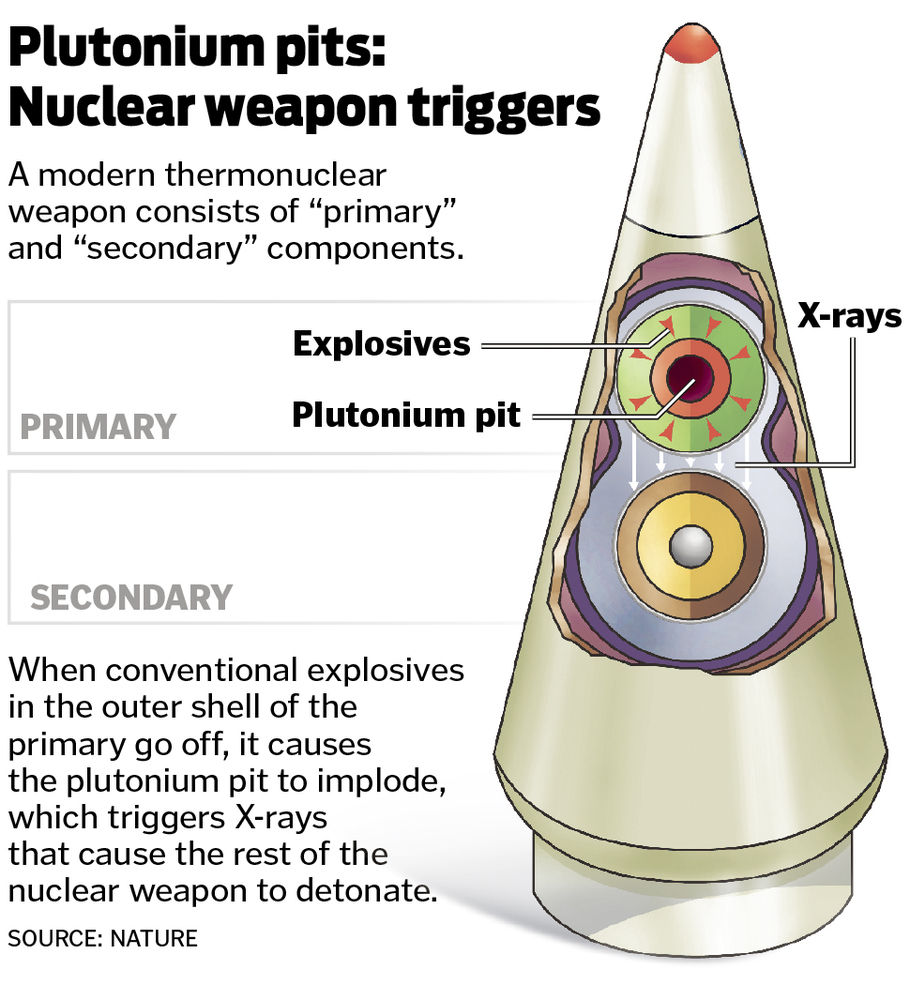
The core of the big modern (relative term here given these designs are pretty old by now) bombs are implosion fission devices that then trigger a secondary fusion explosion. The core of that primary bomb is a plutonium ball called a pit that gets crushed to trigger the initial explosion. Then the xrays released by that get reflected and use in a secondary fusion device in the tiny amount of time the shell of the bomb lasts.
The pit (primary) is a hollow shape that gets crushed, producing a fission explosion. The X-rays released by that are absorbed by a (highly classified) foam encasing the secondary, which vaporizes (explodes), compressing the secondary causing fusion. The foam, and the secondary, are encased in a substantial tamper made of U-238.
The tamper’s mass impedes the expansion of the secondary, making it more efficient. The tamper is also largely converted to Pu-239 by the neutron flux from the secondary, and immediately fissions releasing a whole lot more energy. This approach is used in all modern thermonuclear weapons, with the majority of the total energy coming from fission.
The ‘Tsar Bomba’ weapon, the largest ever detonated, was designed to be a 100 megaton blast, but Khrushchev was concerned about fallout. So, he directed the U-238 tamper be replaced with lead, which reduced the explosive yield to ~60 MT.
Plutonium is very corrosive and sensitive to phase changes so it needs to be refurbished and replaced regularly. The weapons grade plutonium lying around is probably not bomb ready.
Without casting the military as lying, if they declare they have <x> weapons in substantive state to be used, and place them in missiles, then the implication is they maintain a stockpile of pits capable of meeting that supply, constantly.
If we assume 1 pit per month ages out due to phase and corrosion, then they would presumably have a pipeline of 12 pits in refurbishment continuously.
Since the stockpile is still measured in the thousands, I would assume the stockpile of plutonium pits running through pantex facilities is at a similar scale.
(this also assumes there is no neutral gas non-corrosive, phase stable storage)