I'd love to see the numbers on this if you have them in a shareable format. How did your model account for value deflation and what assumptions did it make about storage tech?
It's great that YC provides feedback on why they don't accept (some) companies. However, it's a bit disappointing to see that not having MRR is a reason to reject a company. It seems like a lot of the successful YC companies were accepted way before they were anywhere to close to revenue -- and some were even working on a completely different product when accepted.
My hope is that MRR is sufficient, but not necessary for acceptance!
Maybe I just don't get the Silicon Valley culture, or perhaps I'm missing something fundamental, but let me just get this straight:
1. Startup has no revenue whatsoever, but ostensibly have good product. They go pitch to investors and get rejected, likely because they have no revenue.
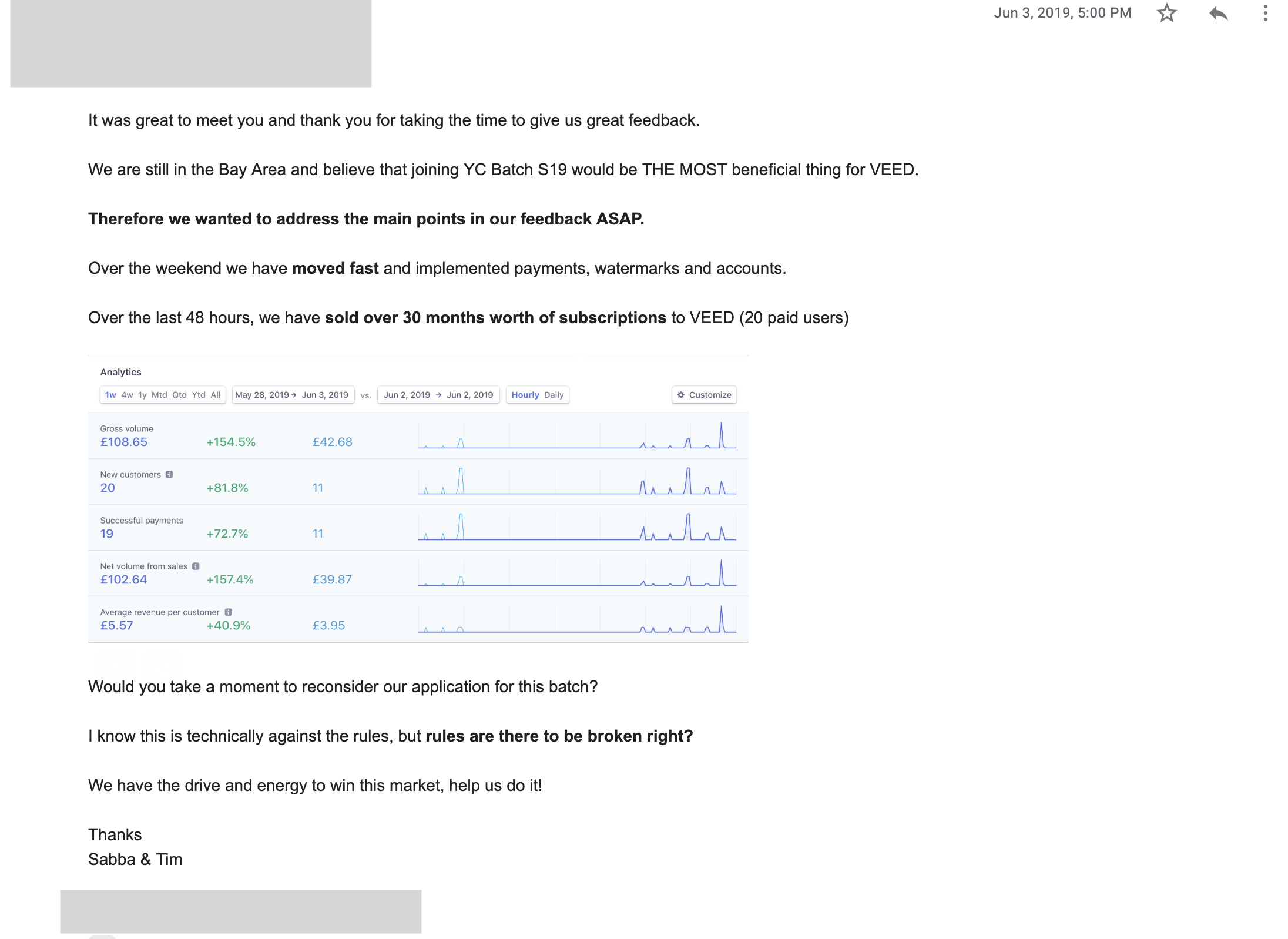
2. They hack around for 1 (!) weekend and get their MRR to $500. Five hundred bucks. They now go back to investors and say: hey look, we now have revenue (peanuts really), can we get funding please?
In what world would those $500 be expected to make a difference? How is that a proof of anything? I expect even really inept startups can somehow pull together $500 revenue from friends and family.
I suppose I just don't get how $500 in revenue could be seriously considered the tipping point between rejection to acceptance for investment?
To my layman reasoning, this is incredibly naive, but I'd like to be proven wrong.
It's the kind of situation that an auto mechanic in Pennsylvania would give a confused look of "kids these days" toward.
Focusing on growth is great but what has happened here feels to me like an inversion of accepted business logic. It seems like there wasn't a thought given to revenue before receiving this feedback.
The funny part about that is how this little bit of $500 MRR would have definitely helped this small team pay their grocery bills, and they could have been benefitting from that months ago if they just...thought about how businesses exist to make money.
The desperation to get into YC feels like an episode of American Idol, where the contestant may not remember what the benefits of being on American Idol are in the first place.
Looking at their site, it's got a few misspellings, a dead link, and some really strange ways of communicating that they used to have no watermarks, but now they have watermarks.
The product seems slick but incredibly limited as well. I'm not sure the idea of a video editor being web based is actually incredibly useful over an installed app.
Finally, they're charging $50 a year for a product that does less than iMovie (pre-installed on 50% of smartphones sold in the USA) or Adobe Premiere Clip (free).
If you stayed subscribed to this product for 6 years you'd have broken even by just buying Final Cut Pro, assuming they don't ever raise the price.
I'm not really surprised that YC had revenue concerns.
I sort of agree, but $500 monthly is quite a bit - it's way more than I'd expect most people who don't already have a significant public following to be able to reach on e.g. Patreon in one weekend. I could probably expect to find $500 from friends and family, but I doubt I could get a monthly commitment of $500 from them.
Except it's not $500 monthly. They claim £250 MRR but they got rejected 2.5 weeks ago so we don't actually know how many of those users will continue to pay next month. I'm not arguing this isn't still impressive for a weekend hack, but it is categorically misleading to claim £250 MRR when you haven't even had a billing cycle yet.
That's the thing. In my mind $500 proves nothing. Well, it proves that you can get $500 a month. I think it says zero about the actual ability of this business to become a success.
Put differently, if I believe in the idea behind a startup, I'm willing to overlook the fact that they have no rapid growth yet. If the idea is not enough to convince me, a miserable $500 is sure as hell not going to make a difference. It's too little in too short a time. It says zero about customer retention or satisfaction, etc. It's akin to taking two data points, zero revenue and $500 MRR and then extrapolating the growth. Nobody but a fool would believe such a metric.
If they went away, hustled hard for 2-3 months and got to say 50-100 paying customers (with that number consistently growing), good reviews or some feedback that customers actually like the product, I'd be more inclined to think of it more than just a fluke.
And honestly, seeing something like this would make me less confident in a startup, because as I said in another comment, the impetus for charging seems to be completely tied to getting accepted by YC, rather than trying to build revenue for the business. "Let's just hack our way to $500 then we can show we have revenue and the objection they listed will be moot and we'll get accepted."
The better move would be to have a solid plan for a pro product, start charging, be able to show growth in paying users, and then reapply for the winter YC class showing those data points.
$500 and then some churn and poof...
You really need to do a stable couple of thousands for a couple of month to “know” you’re paid plans actually provide long term value. Or sell yearly plans.
>In what world would those $500 be expected to make a difference? How is that a proof of anything? I expect even really inept startups can somehow pull together $500 revenue from friends and family.
In practice, this is actually much harder than you'd expect.
Also, competent VCs will probe to understand who made the purchase, and whether they're likely to do it again.
You might have missed it in the article, but their explanation is really apt.
"Therefore, we thought that if we can get first paying users and MRR over the weekend and get back to YC next Monday morning, they would see that we had achieved MRR in only a few days. Additionally, we would look like a team who could move fast, listen to feedback and get stuff done."
The reason they were rejected is because they had no MRR. They were also told they need to move fast.
They proved over 1 weekend that they can get $500 in revenue and move fast.
It's the notion that they got feedback, moved fast to implement feedback, and showed that users were willing to pay on day 1 with a half-baked MRR plan.
The $500 isn't about cutting the burn rate in a significant way. It's just the first domino to fall.
It's very hard to make the first dollar. Customers want to see other people pay you first. That's why many startups fill their websites with logos of big-brand clients, even if they're making very little from each.
It’s proof they can actually make money on the thing, which matters because it sounds it’s soemthing people like enough to pay for so as they grow the user base, they’ll grow revenue. However, keep in mind they still didn’t get in to YC after changing it, so it may not have chances things that much.
Excluding cheating - asking friends and family, or business to partner to boost your MRR -, a few hundred dollars prove a lot of things. Getting the marketing, billing system, and actual product right for this few hundreds is way harder than it seems.
I think they do continue to accept companies without MRR. I suspect they simply value it more in cases where they are unsure if the product is something that can eventually be monetized (i.e. they don't know if people are willing to pay for it).
I found the feedback contradictory. They said: (1) you need to charge for this, and (2) it's a market that no one owns yet so you need to grow fast to capture it.
The surest way to grow fast is to have a free product. I realize that not a lot of time can go into this feedback, but this struck me as pretty contradictory on its face.
It seems that they only added the watermark when they started charging. Pre watermark it is hard to know if the business is potentially viable at all. Free signups might fall off now that they aren’t getting everything for free.
Assuming that is the case the business model would have to change to pro features or add. Maybe VC would be more comfortable on some data on all this.
Their typescript compiler may not be targeting the correct ecmascript version so the typescript generated could be using polyfills instead of native features.
It's a little hard to tell if you're asking "are there laws against monopolies?" or "should there be laws against monopolies?".
The answer to the first is a certain yes. There are laws against businesses forming monopolies in the United States. You can read up on the Sherman and Clayton antitrust acts from the 1890s and 1910s to start with. There is also considerable case law stemming from this legislation.
The answer to "should there be laws against monopolies" is a little more open. One theoretical justification for breaking up monopolies, is that in some cases monopolies cause economic inefficiencies. Look up "deadweight loss from monopoly pricing".
It's very complicated to measure any efficiencies or inefficiencies from tech monopolies, so I don't think there's a clear answer.
It's also not generally agreed upon that economic efficiency should be the goal of government, so there is a lot of room for debate on that question.
You've confused some things. "Economic efficiency", as espoused by Bork and the rest of his Chicago School crew, came as a result of consolidation. His argument against strong antitrust enforcement was that it lowered economic efficiency to benefit smaller non-monopoly companies.
This of course was a disaster for the American economy and it's taken 30 years of increasing corporate concentration for the politics to finally swing back against monopoly.
Can anyone help me appreciate non representational art like that of Mr. Johns?
One specific question I have is: do his individual works stand alone or do you have to understand his life and/or complete body of work and the context in which it was created to appreciate it?
If you saw one or two of his paintings without ever having heard of Jasper Johns would you recognize them as masterpieces?
I remember the moment I walked into the Menil Art Museum in Houston, Texas and saw my first Jasper Johns. They were so simple from a distance but up close had such complexity that they really stuck with me.
Really good art is often both striking without any foreknowledge, but also reveals extra complexity when you learn about the context in which it was made. When you look at a piece of non representational art, before you know the artist, try and think about the choices the artist made, and why they made them. Why is this line a certain thickness here, why is this part more or less transparent?
The process of making any piece of art is a series of decisions, conscious or not and at least to me, non representational art is an attempt to distill that part of creation into a physical form.
Context is fundamental in the appreciation but I think it's much less about the artist's life per se (although that could enrich the experience & interpretation, depending), and more about your cultivated tastes with the medium.
Your experience of food, wine is a function of your prior experience (and -- most importantly -- interest) w/ food & wine. Never had much wine before (like me), and you'll shrug w/ indifference at every glass. But this is only (my) ignorance/lack of interest/etc. It's a lacking.
Likewise, if your experience engaging w/ a painting on canvas is limited and mostly of disinterest/disengagement then so much of any given painting is going to be lost on you. Not completely, but by a large margin it will be.
The last question about recognizing the painting as a masterpiece is a little misplaced or needs fleshing out... No one looks at a painting and categorizes it as masterpiece or not. What one does is look at a painting and is given an experience and range of emotion. If that emotion is intense -- eg, exhilarating or intriguing or aggravating -- then the next question will be -- do I think this is a universal reaction? (I.e., not idiosyncratic to me. Experience guides in answering this follow-up, of course.) Then, if so: does this artist have an agent? Could I be his/her agent (if you think about making $$ alot)? OR: surely this piece is already established its market, ie been established as a Masterpiece by prior or current culture. Anyway what strong emotion typically does in any flesh & blood human is inevitably send us racing after questions like these..
A certain level of context helps, but it isn't necessary to have a complete picture. His painting, Flag, doesn't need much, but it's helpful to know about the USA, what the flag means, nationalism, etc. It further helps to know that he made it after serving in WWII. It follows that an alien seeing it for the first time would probably get less from it than someone coming at it with more context.
But no, you don't need to understand "his life and/or complete body of work" to enjoy it.
These works are best experienced in person. The scale, texture — it all plays a role. It helps to imagine the context, to imagine what if was like for these works to emerge when they did. But, I think Jasper Johns can definitely be appreciated without any of that — just standing in front of one of his works, taking it in like it’s a landscape; just something to experience.
> do his individual works stand alone or do you have to understand his life and/or complete body of work and the context in which it was created to appreciate it?
From my perspective, I'd say it's really more important to know where an artist's work stands in relation to their culture and their contemporaries. Most important artworks can be seen to have extended previous practice, to have influenced subsequent practice, and/or can be seen in retrospect to belong to some coherent zeitgeist.
You may see some works to truly stand alone. But I've personally found it difficult to connect to most great artworks that way.
It helped me a lot by just practicing painting. I enjoyed viewing art before then. But, it wasn’t until I attempted to express my vague ideas onto a canvas that I truly appreciated the masters’ mastery.
Maybe food is a good analogy? (another art form that goes back to Homo Sapien origins).
I appreciate a cake that my daughter makes from a box. But, I really, really appreciate a cake made by a master baker - a unique creation where every aspect (taste, texture, design, display, temperature, flavor, etc.) is considered and balanced into a cohesive whole.
Aesthetics are rooted in civilization, time, and class. It's very difficult to say if these works by Johns will survive 500 years from now given that famous bronze statues were melted down to make bullets. However, if you have time you should try to understand what's happened to fine art in the past 200 years if for no other reason than it's interesting and to challenge your views on aesthetics. Not all of it will last another 100 years, so that gives you an idea where things currently stand too.
One impression that I got from the article, which I thought was helpful, is that Johns's work serves as a transition or bridge between the Abstract Expressionists like de Kooning and Rothko and the more modern figures like Andy Warhol.
The Wikipedia article on abstract expressionism actually comes right out and says as much. So I'd start there, if you want some contextual background.
Yes, he's often described as an early Pop artist, but unlike the more famous Warhol & co., who used and embraced industrial processes, there's a definite "craftsy", home-made quality to Johns' work.
He used encaustic, which is a mixture of hot wax and oil paint, which lends the paintings a really unique texture. There's also often newsprint embedded in the paint, which adds another layer of texture.
Reproducing the American flag in this medium, and at scale, offers all sorts of questions. The red drips are maybe too symbolic, but the embedded newsprint gives a sense of history, and the whole handmade effect just adds to the ambiguity.
I once read some of his sketchbook notes, in which he'd written something along the lines of "try to hide what's going on from the viewer." So, he was being deliberately vague. And somehow it works, at least in his early works.
I first and best understood Jasper Johns in particular 'Flag' (1954 onwards) through viewing a documentary as a teenager.
The narrator described 'Flag' as many things: a flag, a painting, a sculptural object, a commentary and a concept.
These were and remain all true and equally valid.
The historical context of mid-50s America is helpful but not essential. Of more relevance is the disruptive innovation of creating a work both of and outside the system, that ends up influencing the system in return.
It's like a self-aware mutation with genetic and memetic qualities.
Erik Torenberg's Village Global [1] was started fairly recently and is already extremely highly regarded in the start-up community. Much more so than Techstars or any other non-YC accelerator in my impression.
500 Startups and AngelPad also seem fairly well-known. I'd love to hear from someone more involved in the VC community about how those two accelerators are generally regarded.
These mutual funds and ETFs actively participate in corporate governance, and the overlapping ownership of most stocks in the market is a very underrated problem.
Economists have found evidence that as ownership concentration increases, firms act more like a monopoly.
Participating in corporate governance and actively forming corporate strategy is a very different issue. And to my knowledge, ETFs and mutual funds do not participate in any meaningful way in management, i.e. they do not act as activist investors.
One intriguing proposal to limit domain name squatting is "Harberger Taxation"[1]
Under this scheme, every owner of a domain would declare a value for the domains they own, and pay a percentage of that value as a tax (replacing the current annual registration fees).
Owners are incentivized to post an accurate value for their domain because they must sell their domain for the price they list if anyone offers to buy at that price.
While it makes sense in theory, I think there are some practical problems that would have to be addressed before such a system could be put into use. For example, what stops a company with a large bankroll from squashing competitors by purchasing their domain?
That seems totally bonkers for the case of an entity like Google or Apple. Would they really list their domains worth $1,000,000,000,000 dollars? and pay some percent of that a year?
So, I'm an average person hosting my email on my domain. I use it for both personal and professional reasons. I'm by no means wealthy, so even though my email address has huge value to me (from clients, to friends, to banks and digital services) I can't pay a huge price for it.
With your suggestion, someone with enough money would be able to force me to sell it. Identity thieves would have a field day with this!
> While it makes sense in theory, I think there are some practical problems that would have to be addressed before such a system could be put into use. For example, what stops a company with a large bankroll from squashing competitors by purchasing their domain?
The idea is that if I'm a startup that owns google-disruptor.com, I have to declare a value for that domain name (let's say $100,000), and pay a percentage of that value as a tax. I'm then obligated to sell the domain to anyone who is willing to pay $100,000. This prevents me from undervaluing the domain.
Since Google has a much larger bankroll than me, they can purchase the domain for $100,000, and revalue the domain at $500,000 -- out of my price range.
Since Google has a much larger bankroll than you, if they decided that they wanted prickledpear.com, wouldn't you have to sell it to them, or any other party with deep enough pockets?
To clarify, under the scheme being proposed, they actually do have to sell. Otherwise you would just declare your domain has zero value, you'd pay no tax, and then if anyone offered to buy it, you'd say the offer sucks and refuse to sell. So declaring a value is a commitment to sell and pay the tax.
> To clarify, under the scheme being proposed, they actually do have to sell.
That just sounds broken to me. If I buy a domain, I should own it. Someone who wants it should offer what they are willing to pay for it, if I don't like their offer, they can find another domain.
Yes. Total number of visas are not increased but people with US Masters degree will have a higher chance of winning the lottery. I am not a lawyer but based on my reading of the law USCIS is likely going to lose in court over this. Here is the relevant text of the law[1]:
---
(5) The numerical limitations contained in paragraph (1)(A) shall not apply to any nonimmigrant alien … who … (C) has earned a master’s or higher degree from a United States institution of higher education (as defined in section 1001(a) of title 20), until the number of aliens who are exempted from such numerical limitation during such year exceeds 20,000. (Emphasis added)
---
Based on the literal interpretation of law I think it is absolutely clear that the law clearly wants Students not to be counted against the cap until the 20,000 Masters cap is filled. I do not see any way to implement current USCIS proposal without violating this clause. It appears to me that DHS is unable to afford any competent lawyers these days and constantly proposing things that are illegal and not properly thought through.
Ignoring the legality of this move, this move does not benefit US society in any way. Implication that students with US masters degree are high skilled is pretty lame because majority of these students are from fly by night universities that do not even need GRE for admission. Most students after they are done with their masters work on OPT for around two years and seek sponsors for H1B during that time. Many of them simply approach body shoppers and consultancies which operate the low value spectrum of tech and will hire anyone. Also these are the companies at the forefront of most fraudulent activities.
Based on some of the unverified insider information, USCIS director Cissna has had a plan for a four pronged assault on H1B.
1. Simply refuse to renew H1B beyond 6 years. This impacts mostly Indians. He failed to implement this policy after the memo leaked to press.
2. Slow down entire H1B process to the extent most employers lose interest. He has successfully done this. My wife's H1B was filed in April 2018 and was approved in January 2019. No matter how kickass coder she is no employer will ever want to get into that kind of hiring process.
3. Create a system where you simply waste H1B visas each year. One way is to increase the rejection rates for new visas. If out of 65K visas say 10K visas are rejected these are never filled. Second approach which he wanted to implement this year but failed is to have this concept of "pre-registration" which everyone including immigration lawyers applauded. This is a sinister move. Under this move any company can file a lottery even without hiring an employee. After winning the lottery the company may simply refuse to proceed and that visa is wasted. Since there is no serious fee involved here any company who does not even have a hiring plan can enter the lottery and win it. This means a large number of H1B visas will not be claimed at all.
4. Rescind the H4EAD program to hurt families on H1B. Again affects only Indian citizens on H1B. I am told USCIS is unable to come up with good reasons to rescind this program and hence it is delayed for more than 2 years now.
H1B program is in a mess and current USCIS administration is acting in bad faith and making it worse, encouraging fraud and misuse.
> Implication that students with US masters degree are high skilled is pretty lame because majority of these students are from fly by night universities that do not even need GRE for admission
Are you arguing that people with less education are on average more valuable?
If you don't believe that it matters, then why do you care? It would be a purely neutral move. I don't see anything wrong with that.
If you think that this is a negative move, then that means that you believe people will less education, on average, are more valuable than people with more.
> Based on some of the unverified insider information
What is fundamentally wrong, if anything, with people with less education being more valuable? Would you rather have three engineers with an undergrad degree or one with a master's? Where do you draw the line?
In my experience advanced degrees do not equate expertise -- if anything, professionally, it's the opposite.
> Would you rather have three engineers with an undergrad degree or one with a master's? Where do you draw the line?
We are comparing 1 to 1, not 3 to 1.
In the context of this conversation, we are taking about whether it is a bad thing for someone with more education to receive priority access to the H1B visa.
And my opinion is that this is at worst a neutral thing.
The person I was responding to thinks that giving masters students priority is somehow negative.
In order for it to be negative, he would have to prove that these masters students are somehow worse, on average, than the non-masters students.
I think a high school drop out with 5 years of work experience coding can beat a masters from silicon valley university. In tech jobs degrees are in no way indicator of skill.
This is not comparing a person with 5 years if experience to a person without 5 years experience.
Instead, related to the H1B question, this is comparing the "average" person applying to the H1B program who has a bachelor's degree, and comparing that to the "average" person applying to the program with a master's degree.
It is not about perfect correlation. It is instead about imperfect correlation of the averages among these 2 groups.
Even in the worst case scenario of there being no correlation, it still benefits the US to give priority to masters students, as at the very least it means that they have spent more money on an American business (IE, the univerity).
I don't see anything wrong with priorizing more money to US businesses, all else being equal.
> s at the very least it means that they have spent more money on an American business (IE, the univerity).
I am not sure why it matters. Good chance the university is a visa mill and setup specifically for f1 to h1b transition like the recent DHS sting revealed. Such businesses needlessly muddle edu-sector and destroy capital on things that solely exist to bypass government red tape. It adds to economic inefficiency of the society.
Also, that is not the reason USCIS has given. "They spent money on USA business" is the criteria than the law should explicitly state that and everyone can then compete. My wife arrived on H4 and lost to H1B lottery twice. In that time she converted to F1 and then got her OPT is a small college. The degree was worthless and we spent $25K on her education. That enabled her to win H1B lottery in her third attempt in master's cap. Technically beneft to US society was significantly more if she had got her H1B in first attempt.
But that is not the point I am making. My central point is that USCIS policy clearly (I am not sure how much more clear it can get than that text) violates the law passed by Congress. USCIS at the very least need to provide credible evidence as to why this new system is better, why someone with US masters degree be automatically assumed to be higher skilled and based on what evidence and how it links to BAHA executive order whose pretext is being used for such changes. H1B visa is not meant for "high skilled" any ways. It is meant for specialized skill that is in short supply in USA. So there is a violation of far basic principles there too.
Yes. People with less education but few years of experience could be far more valuable than a masters degree holder from silicon valley university which is now shut down. Having a us masters degree is not correlated to higher skill in any way if we are not going to factor in university rankings.
It is very easy to validate claim. How many of the employers in bay area actually ask for masters or higher education for swe jobs ?
If it is a neutral move why waste taxpayer money and potential lawsuites for no benefit ?
My primary argument however is that the move is illegal and completely against the congressional intent.
Actually it says the 20,000 is only for Master/PhDs, so this could reduce the total number of H1Bs issued if there are fewer than 20,000 Master/PhD applicants. Otherwise the effect is more Master/PhD H1Bs and fewer others.
The 20,000 for advanced degree holders already holds in the current system, and it already over-subscribed. So this would not reduce the number of H-1Bs issued.
A large number (most?) of the H-1B visas go to students on F visas who have a job offer and want to change their status. Almost all the foreigners that I know on H-1B visas in my company came from a F visa. Some definitely were recruited from abroad, but it's simple economics. With so many people graduating from US universities, it's a lot easier to interview and subsequently apply for an H-1B for someone already here.