They just use prevailing wind routes, and toss tons of balloons up, and have 'em float over the border cause cigarette taxes are so high in Europe that it's worth it.
And then there's people waiting along the wind path to pick up the balloons as they come down.
There's a lot of inefficiencies built into smuggling operations. You can absolutely grab huge amounts of smuggled items in busts and not end up denting profits for the smugglers cause they're smuggling so much (see cocaine, fentanyl, cigarettes in blue states in America).
I wouldn't entirely rule out the Russians or Belarussions doing probing moves, but the Enforcer's been a great source of information for these events as they occur.
Entirely likely, and my first thought. It would be an ideal and cheap way for Russia to probe responses and results with complete plausible deniability. Jsut testing for another route to destabilize targets.
It wouldn't be a bit surprising from a bloc known for weaponizing regional poverty and migration by aggravating wars to stimulate migration and even literally bussing migrants the borders of Poland and other countries to create instability in target countries.
Or, it could just be some smuggling crew going wild to meet some deadline or get stuff shipped before a coming crackdown. Or both.
I haven't found much utility in reading Russian-language sources, though I can read the language.
Unfortunately I'm not extrapolating, this fits within a very mature pattern. See 'Little Green Men' in lead-up to Ukraine invasion and the drones violating airspace that Poland has been shooting down.
Show any weakness, any concession, any compromise, blink and you get invaded. Its not complicated. They communicate it pretty blatantly internally. And once you are invaded, they do a settlement and education program to have a reason for interventions. The chamberlains of europe and the us, talking to themselves about peace, are inviting them.
There are two elements of this situation that I'm consistently trying to open-mindedly hold in balance.
One part is what I call "The Great Defederalization". In a myriad of ways, the federal state that was erected between FDR and LBJ is being torn down. That state existed on a group of decisions that allowed independent agencies outside of the direct oversight of the president: the Humphrey's Executor agencies, NLRB, FCC, FTC. The Supreme Court and Congress are very happy to work on rolling them back, and they were constructed on pretty awful jurisprudence to begin with. That can work-- we should engage in creative destruction, the administrative state did restrict economic growth, and it did create carve-outs out of the Constitution. If it made us a more reliable partner, that did come at the cost of flexibility.
But at the same time, this executive isn't defederalizing to defer power to the states-- it's doing it to grant more immediate power to the president, who is in effect weaponizing the armed forces and police forces against non-compliant localities and personal enemies. News like this happening the same week as the president sends the Army to a passive American city in order to plainly provoke a conflict, and directing his DoJ to enact a case on paper thin justification, is troubling, to say the least.
> That can work-- we should engage in creative destruction, the administrative state did restrict economic growth, and it did create carve-outs out of the Constitution.
The highest level of economic growth (GDP), and total factor productivity growth, was between 1929 and 1973. It was also the time period when income inequality plummeted (post Gilded Age).
All three metrics have gone down hill since 1980 and the mainstreaming of neo-con economic thinking.
>> The highest level of economic growth (GDP), and total factor productivity growth, was between 1929 and 1973
That's also the time period that immigration to the US was at its lowest. The Immigration Act of 1924 strictly limited the number of immigrants allowed. That law was reversed by the Immigration and Nationality Act of 1965. Only 5% of the population were immigrants by the 1970 census, the lowest in US history. It's close to 15% now, a level which hasn't been reached since around 1900.
Income inequality plummeted because immigrant labor wasn't allowed to enter the US to drive down the wages of US workers.
H1B labor drives down the wages of US workers. Illegal immigrant labor drives down the wages of US workers. If you care about income inequality, then maybe consider supporting enforcing the immigration laws, and maybe consider supporting ending the H1B and other programs that drive down the wages of US workers and increase income inequality.
> Has the surge in immigration since 1970 led to slower wage growth for native-born workers? Academic research does not provide much support for this claim. The evidence suggests that when immigration increases the supply of labor, firms increase investment to offset any reduction in capital per worker, thereby keeping average wages from falling over the long term. Moreover, immigrants are often imperfect substitutes for native-born workers in U.S. labor markets. That means they do not compete for the same jobs and put minimal downward pressure on natives’ wages. This might explain why competition from new immigrants has mostly affected earlier immigrants, who experienced significant reductions in wages from the surge in immigration. In contrast, studies find that immigration has actually raised average wages of native-born workers during the last few decades.
I have heard people claim that cracking down on immigration will increase labor costs for farmers in California who rely on immigrant labor to harvest their crops. That would be a contradiction of your study that you cite.
Can you find an example of the opposite? Can you find me a California farmer who is happy with the crackdown on immigration because now his labor costs will decrease? That does not exist, for reasons of reality.
Where is the corporate support for decreased immigration if it will lower corporations labor costs?
Hmm, the rigorous systems of measure for GDP were only pioneered by Clark and Kuznets in the 30s and collected widely in the 40s. There were measures before then but they had much less rigor. I imagine the 1880s-mid 1920s were pretty impressive. Ditto for the 1830s-late 1850s.
What’s more, that time period includes recovery from the crashes of the early 30s, the massive war production of the 40s, and the massive boost that was having the rest of the world’s manufacturing and demand still in ruins in the 50s and 60s.
You could be right— but the data sure is confounded.
Lots of arguments back and forth about the politics of government workers. But perhaps the biggest argument against the “creative destruction is good” might be that it favors hiring workers who like to leave a lot of the details up to someone else. But the “someone else” people (who like stable, rule/process oriented organizations) will be missing in the asymptomatic solution? (Contrast with an org with stable, rule/process development, where an asymptomatic solution exists?)
The first point requires an additional layer. The modern administrative state has its origins in Woodrow Wilson ideology of scientific governance. Wilson didn’t like democracy and wasn’t much of a fan of the constitution: https://teachingamericanhistory.org/document/the-study-of-ad....
A consequence of centralizing governance in a giant federal bureaucracy is that it’s become dominated by one party: https://www.govexec.com/pay-benefits/2016/10/federal-employe.... That was a predictable result of federalization. If the government is run by unelected bureaucrats insulated from the elected officials, then it’s completely unsurprising it will become dominated by the party that prefers bigger government.
In classic Trump fashion, he doesn’t care about federalism per se, hence his inconsistent actions on law enforcement and crime. But he has a brain stem level reaction that it’s crazy he got elected President and is expected to cajole a federal workforce of 1.8 million democrats into executing his policies. And he’s not wrong about that.
Regarding the DOJ, Thomas Jefferson personally directed the prosecution of Aaron Burr: https://constitutioncenter.org/blog/the-great-trial-that-tes.... So that part isn’t anything new. As to the merits of the case, 18 USC 1001 is astonishingly (and I’d argue unconstitutionally) broad. I think prosecuting people for “obstruction” without an underlying crime is bullshit, but the government does it all the time. And Comey vociferously defended the practice.
> then it’s completely unsurprising it will become dominated by the party that prefers bigger government.
I think you've assumed the conclusion here. One could equally say that if one party becomes overrepresented by people with higher education, that party will become overrepresented in any administrative position.
> Aaron Burr
I find myself more and more often in the position of having to look back many decades for precedent of things that are currently happening. Again, that's not necessarily a bad thing. But the variance of what to expect is wider, and I think it's fair to cast out one's net of expectations wider, and possibly darker.
Burr was a complicated man, doing complicated things, in a newly defined nation that was still defining norms. His trial was no stellar example of how to find truth and remonstrate wrongdoing. And I agree, "Lying to a federal officer" is absolutely ripe for misuse. A critical component of any subjective human system is integrity and adherence to justice. I don't think many people will look at Comey's prosecution and see it as the clear-headed and honest pursuit of justice.
> I think you've assumed the conclusion here. One could equally say that if one party becomes overrepresented by people with higher education, that party will become overrepresented in any administrative position
I think that’s true! It’s another reason why the federal workforce has come to be dominated by one party. But both point to the same result.
> I don't think many people will look at Comey's prosecution and see it as the clear-headed and honest pursuit of justice
I think it’s terrible to go fishing for a technical crimes with the goal of prosecuting a particular person. The criminal laws are written broadly and cannot withstand prosecutors who fit legal pieces together like a puzzle to come up with a legal theory for a prosecution (https://www.lawfaremedia.org/article/charting-the-legal-theo...).
Comey was also involved in the Flynn setup. If Comey is convicted of procedural crimes it will be difficult to feel sorry for him when he used those or similar statutes to pursue other people.
So you're admitting that Trump is weaponizing the DOJ to get revenge on his opponents? How does a NY court and jury of his peers finding Trump guilty of a felony justify that?
  The facts of the case have been covered at length (including by us in a detailed chronology), and the grand jury’s indictment and accompanying Statement of Facts speak for themselves. The prosecution has said that this case is not just about an affair and hush money payments, neither of which are illegal. Rather, the DA has explained the case concerns an attempt by Trump to interfere in the outcome of the 2016 presidential election outcome.[0]


  The hush money arrangement with Daniels occurred just after the Access Hollywood scandal, where Trump boasted about committing sexual assaults, and was finalized on October 27, 2016, twelve days before the election. As described in the Statement of Facts, Trump initially directed Cohen to delay the payments to Daniels until after the election, “because at that point it would not matter if the story became public.” However, “with pressure mounting and the election approaching,” Trump ultimately agreed to the payoff.[0]
He doesn't have to be charged with them, the intention is what matters, but regardless the three points brought up were (as shown in your own lawfaremedia link):
Your quote above from the article you linked says:
> [T]he DA has explained the case concerns an attempt by Trump to interfere in the outcome of the 2016 presidential election outcome.
If the DA himself says that Trump’s crime is interfering with the 2016 election, why doesn’t the DA have to charge the law that covers that, and prove every required element of the crime under that law?
Because that's how the law in NY is written? I'm not really sure what you're trying to argue here, to be honest. The case played out in the legal system, a judge ruled it should go forward, and a jury convicted Trump on these charges.
A person is guilty of falsifying business records in the first degree when he commits the crime of falsifying business records in the second degree, and when his intent to defraud includes an intent to commit another crime or to aid or conceal the commission thereof.[0]
> (a) Except as otherwise provided in this section, whoever, in any matter within the jurisdiction of the executive, legislative, or judicial branch of the Government of the United States, knowingly and willfully… (2) makes any materially false, fictitious, or fraudulent statement or representation
It basically makes any lie about “a matter within the jurisdiction … government” into a felony. No surprise that even a blue state grand jury indicted Comey for this.
The problem with the Comey case is that Trump is publicly pressuring the DOJ and installed his former personal attorney as the prosecutor. It's reported that they did so because evidence is lacking and the former prosecutor was pushed out for saying so. I guess we'll see how the case plays out but you can't deny that is clear weaponization of the DOJ. I don't recall Biden ever doing this.
> No surprise that even a blue state grand jury
Why would being in a "blue state" matter here? I don't think it's a given that grand juries are politically biased.
It will be run by the party that prefers bigger government... unless you remember how much the current administration has expanded the deficit and DHS.
Also, if you're saying that the past 100 years of American history, with all its various technocrats, was the result of a single ideology operating the government... maybe that ideology actually works pretty well?
Other Republican Presidents didn't have trouble getting their policies carried out despite similar civil service party membership and donation distributions.
It's also important to highlight the origins of modern US civil service (read: the Wilson+ era you're referencing) in the anti-Conkling/spoils Congressional factions and presidents of the late 19th century. https://en.wikipedia.org/wiki/Half-Breeds_(politics)#Setback...
As recently as 1880s the US was still assigning important civil service roles to whomever donated the most money to election campaigns.
The 1880s - 1970s generally featured a more protected civil service, with both advantages (insulation from changing presidents / legislators, maintaining institutional knowledge and competence) and disadvantages (insulation from performance-based hiring / firing, optimizing for bureaucratic rules became more effective than doing a great job).
The latter of which and anti-government sentiment post-Nixon drove deregulation and more direct executive control of the bureaucracy (e.g. the OPM).
As with all pendulums, we're now again seeing the excesses of affording too much power to the presidency (firing institutional knowledge because their role/expertise isn't currently politically en vogue).
Hopefully post-Trump this will spur reinforcing and insulation of civil service expertise.
There is expertise, but there is also ideology. To use the plane analogy everyone likes: the pilot should use his expertise to fly the plane, but he doesn’t get to choose where the plane is going! When you “insulate” the civil service from politics, what you end up doing is privileging the ideology and political goals of civil servants over those of voters.
But to continue your analogy, the pilot is also totally correct in refusing to crash the plane into the ground or jettison passengers out the door because they're brown.
The current state of affairs is not some mere disagreement of ideology.
> When you “insulate” the civil service from politics, what you end up doing is privileging the ideology and political goals of civil servants over those of voters.
No.
You end up balancing the current political desires of voters with institutional expertise.
Or to put it another way, would you say that "competency" is a political ideology or an objective fact?
It's not impossible that there's something here, but I think this sort of presentation isn't likely to convince linguists.
I in particular am not a huge fan of the infographic[0] that uses the same image asset to refer to a spiral, box, sun, dots, etc... for entire continents, for all recorded history.
I would prefer to see pictures of these symbols, and their in-situ neighbors, and a corresponding symbol across a wide distance that's within at most 2-300 years.
We want to feel that language has commonalities, that people traveled long distances and times and kept some common bond. It might even make intuitive sense, if the people share cultural similarities. But it often results in linguists making motivated decisions without enough evidence, like happened with the "Altaic"[1] language family.
"I think this sort of presentation isn't likely to convince linguists." Speaking as a linguist... you're right, it doesn't convince me. Nearly all languages have more sounds (phonemes) than the symbols shown in most of those infographics--more consonants, even (many early writing systems only represented consonants). All languages have more distinct syllables than any of those symbol systems (many early writing systems were syllabic). And obviously all languages have far more words (or morphemes) than any of those systems.
What would be more convincing? A sequence of a few dozen symbols in some particular location, and likely to have been written at the same time (rather than centuries or millennia apart), by the same person (so if there were handprints, the handprints would be the same person's hand(s)), where the number of recognizable symbols is twenty or more. I don't say that would be all that would be needed to convince linguists, but it would be a start.
Can we say "language representation that is not a transcription of a spoken one"? A sequence of symbols could have meaning without mapping to sound, and taken at face value the separation on the map would seem to imply that any spoken language could have evolved dramatically out of sync with any physical representation. I can't think of any reason to think that - if you assume a phonetic interpretation - a symbol shared between North America and southern Africa would be pronounced at all similarly in both locations when the marks were made. The distances alone argue against a phonetic interpretation to me.
Do hobo signs count as a language? That seems intuitively much closer to what this might be. How much structure do you need?
"Can we say 'language representation that is not a transcription of a spoken one'?" Of course: sign languages. But sign languages have even more "phonemes" than spoken languages do, so this doesn't help the hypothesis.
And yes, "A sequence of symbols could have meaning without mapping to sound": that's what hieroglyphic writing systems were, more or less. Again, more distinct symbols, not fewer.
"Do hobo signs count as a language?" Depends on how you define "language". As most linguists would define language, though, the answer is no. All normal spoken or signed languages have oodles of structure (grammar). Pidgin languages probably do not, but that's just the first generation or so, after which they gain structure and are technically creoles. (Some creoles have the word "pidgin" in their names, like Tok Pisin of New Guinea, and Hawaiian Pidgin, but they're complex enough to justify the term "creole.")
Odd that you say “nearly all languages have”, which would include that other languages you yourself can think of, do not have “more sounds[…]symbols…”
The problem I have with “experts” when it comes to this kind of dogma challenging thing is that they are usually extremely biased and limited by that dogma.
Let me put it this way, if you saw those symbols on Mars, would you not consider them a form of communication or language. Ironically, to me at least, the limited ands relatively consistent nature of the symbols itself actually qualifies it as language, not disqualifies it.
Two languages I can think of that have approximately the number of phonemes that some of those sign lists have are Hawai'ian (at least 13 phonemes, depending on how you analyze vowel length and diphthongs) and Central Rotokas (11 phonemes). But that low a number is extremely rare among languages.
"...if you saw those symbols on Mars, would you not consider them a form of communication or language" Communication, yes. Language? Knowing nothing about Martians, I'd have to withhold judgement. On Earth, language is much more than just communication.
The problem I have with people who put "experts" in quotes is that they are usually extremely biased and are limited by dogma, arrogance, and ignorance.
I’d also need to see statistics - without any selection bias introduced by what the researcher finds interesting.
There may be 30 or so “common” patterns that appear globally - that would be very interesting if the total pool of symbols was say 50 but much less so if there are thousands of different symbols.
There are instances in South America, North Africa, and Australia, where some prehistoric person took the foot of an animal such as a large bird or lizard, with feet that resemble human hands, and stenciled round it onto a wall. Is the repetition of this trope over wide distances just a freaky coincidence? Yes.
Well, there's probably something mimetic going on, like the idea of stenciling round your hand at all. "Neat! I'm gonna do that too! I'm gonna get my little brother to do it! And my chicken! And this leftover lizard foot!" Memes spread easily. Kilroy was here, nobody writes that one on walls any more, and hands were stenciled over thousands of years, but we have an evolving culture now.
> Kilroy was here, nobody writes that one on walls any more, and hands were stenciled over thousands of years, but we have an evolving culture now.
Not in the relevant sense. Nobody writes Kilroy was here anymore, but we continue to do hand outlines. That's not a practice that has changed over the last 50,000 years.
I suggest the symbols are morospiles. That's a term from Greek meaning "stupid blemish". This too can be tested: get a bunch of stupid people together to paint on a wall, see what marks they make, measure the degree of similarity to cave art, write a paper about it titled "Maybe They Were Stupid?". Repeat this a hundred times and you've got a field of study to cite authoritatively.
Your statement is a narrative illusion. Science is about pattern seeking and then correlating data about those patterns. They have zilch to do with one another.
Without a time machine, that opinion is no more valid than people keeping a consistent mapping and storytelling language by drawing in the dirt. There is evidence on both sides.
For example, the picture of the entrance stone on this page uses spirals:
The spirals from Newgrange. Those are indeed claimed to "resemble phosphenes" in Does the Nervous System Have an Intrinsic Archaic Language? which this person posted in another comment. They are neolithic, which is a very long way from paleolithic, not just in time but in development of ideas. The paper has another montage of images with the Gundestrup cauldron in it! That was made in the small hundreds AD. It's just a grab-bag of anything that looks shamanic to support the thesis "maybe they were tripping", about everybody everywhere throughout time, and yes, fair point, maybe they were tripping, it's worth bearing in mind. Also, maybe they were stupid. So what? Is this a solution to any problem?
Not so. As these are isolated occurring form constants popping up outside of any possible diffusion, their universality prior to symbolic or pictographic coherences indicate an interim state between expression and symbol.
The rush to claim these are a language is unsupported and is quite suspicious of a retrofitting that's prone to pseudoscience.
I would read Paleoperformance and Paleopoetics for discussions about pre-literate, pre-symbolic cultures from the archeological evidence.
Imposing intent or causality onto these is a bit bizarre.
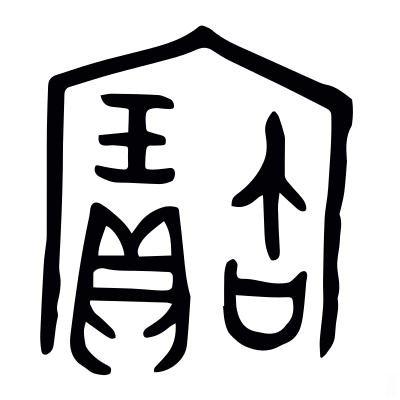
I'm interested to know if the top left character in both Europe and North America actually looks like that. It's the radical for roof in Chinese. Chinese characters are known to have persisted unchanged for thousands of years.
I loved the infographic, although it's clearly overly simplistic it does suggest a sense of where there is no claimed extent of a symbol-type, which might in some cases support broad patterns of domains of exchange. It generates interest.
The real linguistic question is not whether the art had representational value and thus was a form of communication: this is known and clear, simply through the frequent nature of pictographic forms of recognizable elements of the environment.
Rather, it is more to what extent there was a systematization of the pictographs through phonetic or phonosyllabic use, and to what extent any such symbol repetition indicates a depth of shared culture across spatiotemporal divides. At what point does it count as 'writing'?
In general, there was clearly shared culture (technology meant that options were somewhat limited, and we have traced major changes such as the ingress of dingoes from Asia to Australia). What we are learning recently is the hitherto dismissed extent to which disparate branches of hominids survived and persisted in pockets across time, how we mixed with them and adopted their features. IMHO grand colonial theories of migration (often patriarchic/single-event/unidirectional) are falling away as novel evidence such as mtDNA shows far longer admixture and pluralistic bidirectional flows of culture, genes and technology.
Personally, having seen some ancient cave paintings near the northern Burmese and Vietnamese borders as well as in Australia and most recently in a book on Baja California, the similarities are striking, but this does not mean people teleported across the globe. It seems early peoples globally worked a broadly similar techno-social palette to leave marks across time, persisting their identity and expression in ways which probably marked social presence, status, ritual and interpretation. Stories became written and illustrated, but only in summary. Usually we cannot recover the actual content because all that is left are cues, other times modern anthropology preserved traditional interpretation. We often see presumed or literal figures, animals (spirits? gods? prey? food?), weapons, abstract markings, celestial bodies. Things that would be notable in such a society. 20th century anthropology has shelves of studies on this stuff. Here in Sydney, a city of 4+ million people, there are many aboriginal sites with engravings of people, emu, fish, dolphins, turtles, whales, kangaroos, reptiles, etc. Further north, even far inland, there exists rock art of early European ships sighted on the coast, suggesting use for record, story-telling, teaching.
We only know of the symbol use (if they were symbols) that happened on media that lasted tens of millennia. If they even painted symbols on deeply underground cave walls, they likely had them on many less durable surfaces as well. There could have been a huge oral tradition augmented by drawn memorization aids on durable but not that durable media. That augmented oral tradition would then occasionally, every few dozen generations or so, due to some exceptional circumstances, spill over to the near-eternal medium of a cave wall.
A lot of these are so simple its not unbelievable to think that people simply came up with the same things as everyone else inna similar time without ever meeting. Im not seeing swastikas or equilateral triangles, just shapes that look to be simple representations of natural things perhaps.
> I in particular am not a huge fan of the infographic[0] that uses the same image asset to refer to a spiral, box, sun, dots, etc... for entire continents, for all recorded history.
That infographic has bigger problems.
>> The similarities suggest the marks are more than just random scribbles
Except here are some of "the marks":
x # |||| * 一 (hand)
OK, a hand is a complex shape. It does suggest there's more going on than random scribbles. It suggests...
...
...that the people who drew a hand had hands.
Every single one of the other marks -- and the hand mark, too -- are things you could expect to find if you gave a small child some paper and crayons.
Worth noting that the hand “mark” is actually just a handprint—put hand on wall, spit pigment, done. To continue your comparison, it is essentially finger painting.
I heard Volcker speak once, you could still see him remembering how hated he was for those years of the Volcker Shock on his face. Strained and a little sad.
As he raised the federal fund rate to 20%, Volcker became widely hated indeed. Businesses and consumers suffered because of his actions.
Politicians of course tried to take control of the Fed. They also tried to fire him. At one point he needed Secret Service protection. Here's an article from the 1980's about it:
I'm trying this with learning piano, and I see the advice in a good number of places-- if I make a mistake in a phrase, I repeat the phrase 5-7 times correctly, instead of pushing through. It's been working out well so far-- I'm not 'burning in' my mistakes.
At some point, identity relies on an official who is legally empowered to make a decision, and people stating things where lying would be fraud. We currently have very weak intermediary steps in the US-- transmitting 9 digits that last a lifetime-- that could be firmed up in similar ways to 2FA and notarization
A core economic concept is externalities, positive and negative. Positive externalities are undervalued by the market, negative ones are overvalued by the market, like cigarettes.
There aren't many ways to resolve externalities. If you pay people to quit cigarettes, people start smoking to get paid for quitting.
For negative externalities, sometimes you just really have to make the good more expensive, or we'll end up bearing the much larger societal costs down the road, like we did for lead in gasoline and widespread cigarette smoking.
My mom, dad and sister have all done 23andMe, so it doesn't matter if I have or not. They have an entirely complete genome for me.
I agree with your limited license idea. It's just not ok that something like that can be dischargeable in bankruptcy. We don't have the ability to refuse consent in the first place, if our family provide it.
That's a lot of information, but it is in no sense a complete genome. It does mean that someone who had that information could prove that your DNA belonged to a child of your mom and dad with high accuracy, or that you were a sibling of your sister. It also reveals that you don't have certain mutations, or that you do have a few.
But where your parents have different SNPs, there's no way to derive which of them you inherited. What you said is a bit like saying that, because you know all of the cards in a deck of playing cards, you know what hand someone is holding, except in a counterfactual world where there are 10,000 possible cards and you know that a deck only has 52 of them.
When people describe DNA as PII, I don't think they imagine being involuntarily cloned (yet..), I think they're imagining heritable conditions becoming public information through data leaks.
People have a right to privacy from imprecise yet correct information about themselves. Someone wouldn't want to explain an abusive parent to a prospective employer, but they could see a strong tendency to, schizophrenia, with DNA data leaks.
How can they link your family's DNA to you if they don't have a profile or account for you? How do they know you exist? And if they know you exist, how do they know you are related to that particular family without some DNA information about you to link to them?
OSInt will happily fill in the rest. Even if you don’t have a social media footprint, your family does and they shoved their contact list, with you in it, to Facebook 10 years ago.


I can see a lot of reasons for Belarus and Russia to create lots of contacts in EU airspace. The strategy is called "salami slicing" [0]
Especially in light of the point the others are making-- this is a really unreliable form of smuggling.
[0] https://en.wikipedia.org/wiki/Salami_slicing_tactics