I’m surprised ONLYOFFICE isn’t more popular in more distributions. It’s AGPL, open source, and almost infinitely more intuitive than LibreOffice to anyone coming from Microsoft Office.
The linked GitHub repo clearly says Apache License, but their commercial website does say AGPL. They're not even remotely similar.
The AGPL is regarded as so toxic that nearly all companies where office suites matter, place it on a "do not use" list. It's a good way to artificially limit your potential customers. It doesn't matter that they have a page saying "sure go ahead and use it internally" - most places won't touch it with a 10m pole, by policy.
AGPL DOES NOT restrict ability to be used internally.
Agpl does NOT restrict selling software as it is.
Agpl does not restrict using agpl software with proprietary software.
Only thing that agpl prevent is, IF YOU MODIFY AGPL SOFTWARE, YOU HAVE TO GIVE SOURCE CODE TO USERS.
Your modifications. Thats it.
AGPL DOES NOT MANDATE upstreaming modifications. You can do it or you cannot. Your choice. Others can choose to upstream or fork or Downstream your modifications
What you are confusing with is the fud google spreads about agpl. They dont touch it because if they modify code they have to release it but they don't for reasons known to them.
Again, AGPL is NOT viral like SSPL which is like AGPL but on steroids.
Please make your substantive points without fulminating or calling names. This is in the site guidelines: https://news.ycombinator.com/newsguidelines.html. In addition, it's in your own interest because it will make your argument much more persuasive.
Edit: we've had to ask you this at least once before: https://news.ycombinator.com/item?id=32387908. Can you please stick to the rules when posting here? We have to ban accounts that won't, and I don't want to ban you.
And the weirdest part about the complaint is that this is an application your employees could run on their computers to write documents. It's not like the discussion is about a library or package to be included in the product you're shipping.
With large companies with 100s of partners and contractors what is internal is fluid particularly over the network. So am sure they don't want to use such as a library.
Though I am not lawyer/license expert so that fact may be irrelevant more so using it as desktop app. But perception matters, if Goog/MSFT are not using it, a startup also won't risk using them lest some auditor flags it in next round of funding particularly if alternative is few dollars a month.
Be is it may, there are companies like iText (Java PDF library) which are actively harassing companies which use their software, even if the use is perfectly legal (e.g. internal server software). So it's not only Google spreading FUD but companies which try to use AGPL as a trojan horse and then strong-arm users into commercial licenses.
The problem with AGPL is, that the definitions are very open to interpretation. What is a network, how many systems do have to be between to the end user and the software component to still count as "interacting over a network", etc.
So I would also not recommend to use AGPL in your company...
That’s so sad. I’d hate to work at a shop that wouldn’t allow AGPL’d software for internal tooling. What a completely legally unnecessary, productivity-hobbling decision.
Perhaps the best feature of the AGPL is that it predominately hampers companies with ineffective legal departments.
Due to their size, they must have one of the best legal department in the world. Also, their core business is search, and data processing in general. They have the means of using such software and doing what it takes to comply with the licence without putting themselves in trouble.
My guess is simply that they don't want to. They prefer to rewrite it, which will allow them to monetize their tools as proprietary software later. They are already overstaffed with some of the best developers, they can rewrite stuff, and they don't really need help from the open source community, that's why they don't release under copyleft themselves.
Pity. They said it’s because they’re afraid someone outside Google would use it, which is legitimate for companies without sufficient technical SBOL controls to prevent using third party software in violation of its terms. Their take is basically “we don’t have a way to keep our internal software internal, so you can’t use it at all, ever, for anything”. I wouldn’t have expected that of them.
Viral, perhaps if you integrate a library, but in this case it doesn't make sense, you only need to distribute source code if you modify it. Poisonous makes no sense to me, can you clarify?
Hmm, it sounds to me like so much of our world is poison, then. Most surveillance-capitalism software (so the bulk of the most popular websites) are for example poisonous then, no? Unless you'd like to argue that unintentionally turning yourself into a research subject isn't really harmful, in which case I argue accidentally using a license that requires you to share any licensed code you change to also not really be harmful.
You can do whatever you want with your code, you just really shouldn't act surprised when people avoid it so it can't hurt them. They don't see the tradeoff as being worth it. Maybe they don't in the other cases you are presenting as "poisonous" but in those situations they either aren't aware that it's posoin or they are aware and think that it's worth the tradeoff. Regardless, businesses have pretty much universally decided to avoid. I think that speaks volumes.
> Regardless, businesses have pretty much universally decided to avoid. I think that speaks volumes.
I don't typically make my decisions based on what businesses "universally decide" (have they actually?). Most businesses are shareholder or private corporations that find margin between labor and sales; I instead structured a business as a co-op and that seems to be working just fine. Many businesses profit off polluting the environment or selling weapons; I've never worked DoD or O&G (and never will) and lead an extraordinarily comfortable and privileged life regardless. Many content creator businesses lock their content behind paywalls, riddle their sites with ads and tracking; I put up a simple blog in html and css and my audience might be small but they are engaged and are in conversation with me.
I'm not trying to say i'm a special ethical snowflake that's better than everyone else, I'm saying I don't really take it as a given that "businesses doing things in a certain" way really means much of anything at all. In fact I've found often profit correlates with harm (and that businesses often make decisions that don't lead to long, long-term profits but rather pillage themselves for short-term profits), O&G being a great example, so I might even be able to take "businesses do it that way" as a warning to not do it that way or I might be hurting people.
I think you're taking my criticism of the license as an indictment of your personal licensing decisions. I don't really have a problem with you licensing your software the way you choose to. You mainly seem to take issue with the word "poison", that's how I see these licenses, but it was never intended to be about the morality of using them. I'm also not talking about whether businesses are being moral in their other practices unrelated to licensing, I am just saying it's NOT shocking or surprising that they avoid potentially harmful (to them) licenses even if they could maybe save money by doing so. Even if you think that they AREN'T harmful (to the businesses) that's clearly not the perception they have, otherwise companies are leaving free money on the table which I doubt most informed companies are willing to do.
I don't care to continue the conversation where you justify your actions to me, it's just not necessary. I just wish we would stop acting like it's confusing or we don't understand why businesses respond the way that they do when confronted with the decision to use AGPL software.
Maybe it's just a messaging/marketing problem, I don't know.
> The AGPL is regarded as so toxic that nearly all companies where office suites matter, place it on a "do not use" list. It's a good way to artificially limit your potential customers.
Then it's no worse than any proprietary software; if they pay for a commercial license then it's fine. Of course, if they use it internally then AGPL is also fine.
> I’m surprised ONLYOFFICE isn’t more popular in more distributions.
There's an RFP/ITP (Request For Package/Intent To Package) issue for Debian filed in June 2020, but no evidence that any DDs have wanted to pick it up or start working on it. I guess LibreOffice works well enough for all of them that need it.
> It's [...] more intuitive than LibreOffice to anyone coming from Microsoft Office.
I've just had a look at some of the OnlyOffice screenshots, and they mostly look like it has a Ribbon-style interface. It might be that Debian devs are mostly old-school enough that LibreOffice's classic menu and toolbars is more similar to the MS Office they used to use than a Ribbon.
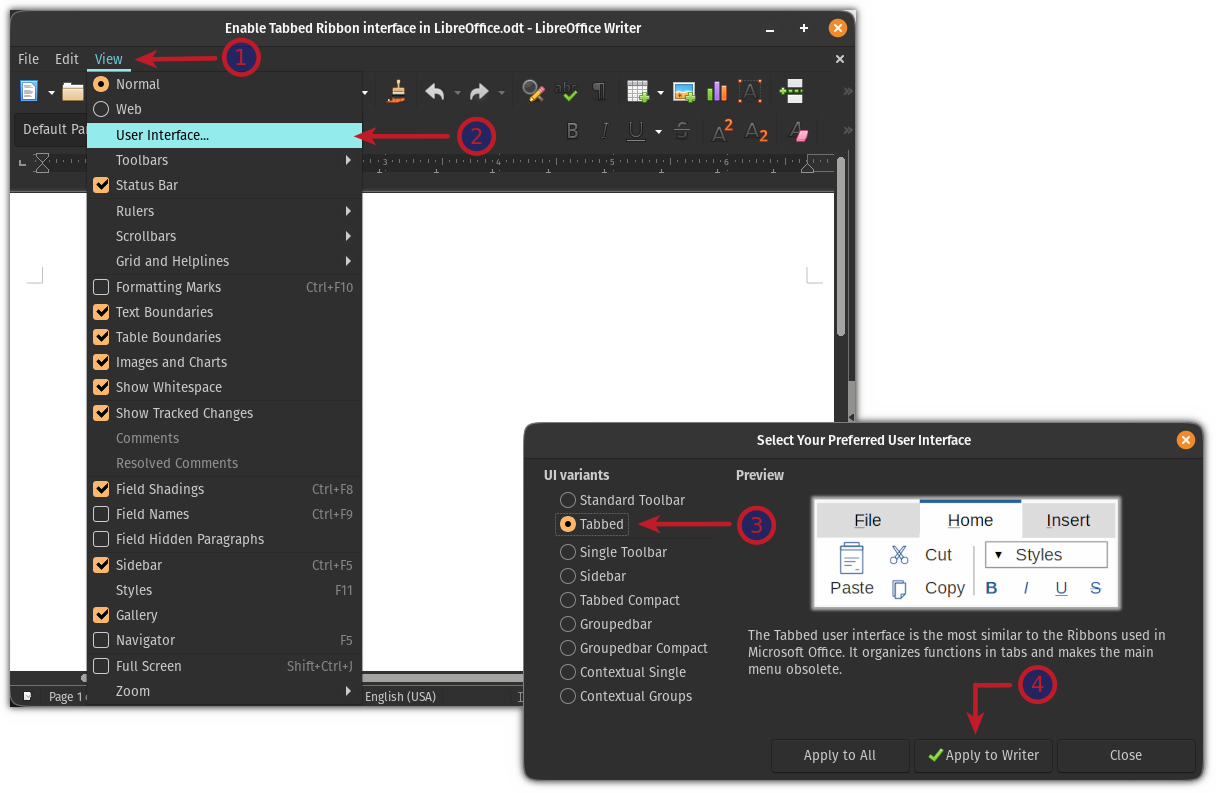
That said, LibreOffice does have multiple User Interface variants (accessible from the "View" menu in the standard UI), including a "Tabbed" option that is Ribbon-like if that's more your thing. (And some others, but I've not explored them much.)
The company has quite some links to Russia. Until recently it was owned by a Russian company but headquartered in Riga, now they seems to have moved the headquarters in Singapore according to this Wikipedia edit: https://en.m.wikipedia.org/wiki/Special:MobileDiff/117266616... (which I'm not sure I can trust completely as there as been multiple attempt to remove any mention of Russia on that page)
But if I had to guess, the major development effort is still done in Russia.
My only serious gripe with OnlyOffice is that when opening a CSV, you have to choose an encoding and delimiter, and there is no way to set a default. You must click twice, in two places, every single time you open a CSV.
So true... opening a CSV in Excel is like playing the lottery. Sometimes it opens fine, sometimes not, it even depends on the character encoding of the CSV and whether you double-click the file, open it or drag it inside Excel. Sometimes you get the "import text file" window where you have to choose the delimiter, sometimes everything gets in a single column, and sometimes you get what you want.
CSV is not a standard (rfc4180 exists but only very few things actually pay attention to it) so no behavior is a sane behavior when trying to import it.
A normal user interface would guide you away from using CSV in the first place.
In almost all situations where one could use CSV, a better, more structured, more standards-compliant, more optimized file format (like a SQLite database) would be a better choice.
In situations where people are opening a CSV file in an office-suite spreadsheet app, they probably didn't generate the data themselves. Lecturing them about how their spreadsheet should have been a database isn't likely to help, and describing SQLite's file format, which is well-documented but not a standard, as "more standards-compliant" than a file format with an actual RFC is bordering on ridiculous.
The Library of Congress, an agency of the legislative branch of the U.S. government thinks that SQLite3 [1] is a acceptable database format.
The Library of Congress has a small amount of SQLite files in its collections.
The Library of Congress also cites CSV [2], Comma Separated Values, as strictly specified in RFC 4180 as a acceptable dataset format. No other types of free-form CSV that aren't variants compliant with 4180 are accepted, and it also says that documentation and metadata needs to be supplied with additional separated archives in supported data formats.
The Library of Congress has 0 CSVs in its collections, and as a result no experience actually handling it.
I believe that if a widespread format such as CSVs have 0 files added to a reasonably well known and encompassing collection of human artifacts related to culture even with its ubiquity, it's a telltale sign that it isn't a standard at all.
This is all completely irrelevant. No office suite user gives a shit what the Library of Congress thinks about database formats, because spreadsheets are not databases, no matter how often you personally conflate the two.
Furthermore, the LoC's job is archiving. Your links have "preservation" in the url for a reason, and "preservation" is not what people do with spreadsheets. To strive for relevance, explore https://data.gov, where CSV is abundant, because it's in use by literally hundreds of state and federal agencies, often by people using spreadsheet software, and will continue to be so for years or decades to come, whether you understand why or not.
edit: Your assertions are wrong anyway, as the LoC does indeed have CSV artifacts in its collection. It is most often in a Zip file and catalogued as "compressed data," which is probably why your perfunctory search did not unearth it. Some random counterexamples to your claim:
> This is all completely irrelevant. No office suite user gives a shit what the Library of Congress thinks about database formats, because spreadsheets are not databases, no matter how often you personally conflate the two.
I did not conflate database and dataset. I specifically described the two types. The Library of Congress specifically describes the two types.
You decided that "others" think that database and dataset are conflated, and that they are wrong.
> edit: Your assertions are wrong anyway (...) Some random counterexamples to your claim:
It's not my assertion, it's a assertion by the Library of Congress itself. The Library declares that it has no experience directly handling CSV.
> "LC experience or existing holdings": None in relation to collection holdings [1]
> "LC experience or existing holdings": "Report of actual practice at the Library of Congress." [2]
This will be my last response to you, since you seem to be ignoring actual points and veering into irrelevant pedantry, which is not particularly helpful to anyone. But because you keep structuring your posts with links in pursuit of a veneer of credibility, like some kind of reverse-Batesian mimicry, wherein something toxic might mimic something palatable in order to lure unsuspecting consumers, I will summarize for the benefit of our readers.
You asserted that "In almost all situations where one could use CSV" there would be a better choice, and suggested a database format. Aside from weasel words like "almost" making the statement inapplicable, the assertion itself is impracticable, for the reason I discussed, viz. in most situations where one is using CSV, one did not choose the format. Nothing you have said (or, I speculate, can say) contradicts this central point.
Your blathering about the Library of Congress is completely useless, since you appear to extract from a specific datum (the Library of Congress preservationists reporting no preferential experience with the format in relation to their collection) the irrelevant misinformation "The Library of Congress has 0 CSVs in its collections," which has a remarkable combination of qualities, i.e. not only does it have no bearing on the topic of this thread, it is also a lie, or at the very least a mistake borne of an inability or unwillingness to read the text you keep linking.
So in conclusion, nothing you have contributed to this discussion is of use to any office suite user while considering the ease of opening CSV files, and even if the information you have provided were of any utility value, it's not reliable. Congratulations on a perfect record, then, of not helping. I hope for the sake of those around you that your skills at identifying relevance and pursuing accuracy increase markedly and quickly.
> I’m surprised ONLYOFFICE isn’t more popular in more distributions. It’s AGPL, open source, and almost infinitely more intuitive than LibreOffice to anyone coming from Microsoft Office.
As someone who doesn't even know MS Office well enough to know what I'm missing, what's unintuitive about LibreOffice to someone who knows MS Office?
It's quite intuitive if you learned on Office '97 or anything up to '07. If you learned on '07+, you might want a ribbon interface instead. But LO has that available; not sure how good it is.
I don’t believe that they have very much proprietary code. I know that if you spin up their document server “community edition,” it has a limit of 20 simultaneous users without a support subscription.
This, however, can easily be legally patched around. It’s more just to make a point that it’s not supported without talking to them about a proper deployment. They also might have some code that is proprietary to make that large deployment easier, but it’s not required as long as you don’t mind the AGPL.
You can actually try this yourself with their NextCloud plugin. LibreOffice also has a cloud version available but it’s… let’s just say, in my opinion, it’s very bad.