I remember that story and it kind of remained with me. As soon as I saw the title of the "game" I recalled this part of this story:
> ... turn around, see my dad being really close to the dog when all of the sudden a big chunk of ice around him breaks loose, tips over, and my dad falls in. I freak out. Then he stands up, the water only reaching about hip height.
At the end of every episode in "Once Upon Atari," Rob Fulop (author or co-author of Demon Attack, Night Driver, Space Invaders, and Missile Command for the 2600) talks about how many children in the 80s played thousands of hours of Atari 2600 games and the effect that it had in their psychological development. Specifically, he believed it produced a nihilistic generation due to the overarching message that "you always lose" in the end. He contrasts it to the early television he watched as a child where the overarching message was "it will all work out" in the end. He says that he thinks about this a lot, and that him and everyone at Atari is responsible for that.
That seems a little harsh. It was a nihilistic time. Missile Command was brutal, but no more so than The Day After[1]. You always lose pinball in the end, too, but nobody blames that for ruining the youth. Well, nobody in that generation. Previously, like everything else novel the youth do, it was Satan's handmaiden.
I agree that he's probably overestimating Atari's impact on an entire generation's psyche, but I like that a) he's indirectly reminding artists to stay conscious of the emotions their artwork provokes in people and b) that's he humble and introspective enough to accept and admit the possible negative by-products of his work.
Indeed. To paraphrase Alan Watts, life isn't like a pilgrimage with a very important goal at the end, it's more like a musical thing, and you are supposed to laugh and sing and dance throughout, not just wait for the final chord.
More on this subject: The Creation of Missile Command and the Haunting of its Creator, Dave Theurer
> Missile Command was a social commentary ahead of its time. One that resulted in the haunting of its creator through constant nightmares, punishing him with a reminder of the value of human life and just how quickly that can be taken from us.
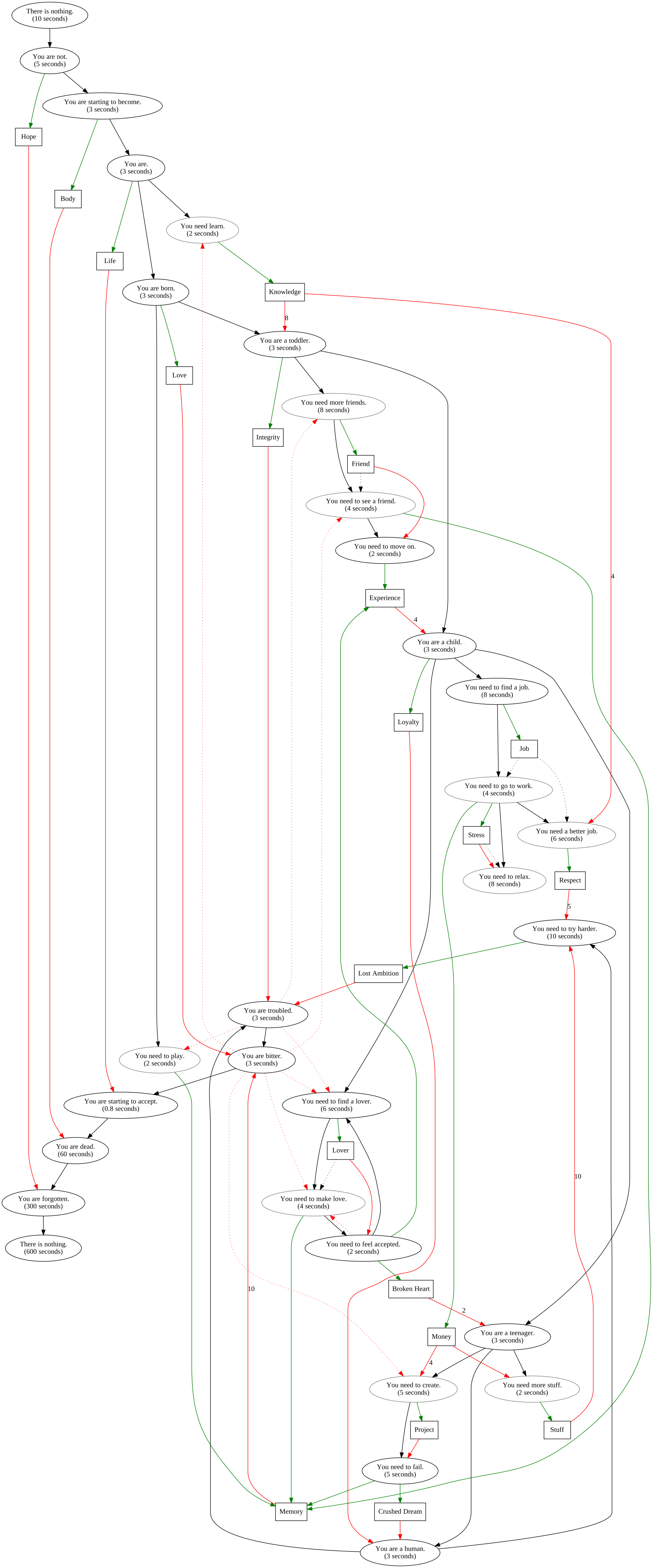
  - Round nodes are problems
  - Rectangular nodes are things you can have
  - Gray round nodes are problems that don't go away after solving them
  - Green lines are things solving problems gives you
  - Red lines are things needed to solve a problem
  - Dotted black lines are things you need to have for a problem to appear
  - Dotted red lines are problems that disappear when a problem is solved
Thanks that is it a dot graph? OK I see, it is. I recall (not a CS grad here either) using that on something complex I did several years ago. Your graph really puts Notch's logic and my decisions while playing his game, into perspective.
Wow. This really struck me - what an incredible piece of art. Thank you notch, for helping me to spend some time this morning reflecting on how I want to live my life.
This is great... I love the way it lays out popular ways of narrativizing our lives and making sense of what we need to be content. This game captures a popular narrative and popular needs, but it's also a great starting point for ruminating on how we differ from each other. For example, some of us may have little ambition or no pressing need to create and yet may be perfectly content. We should recognize our own needs as important to us while also viewing them as deeply personal and not necessarily universal.
This isn't a knock on the game in any way. I love how it cleverly expresses one man's view on what matters in his life.
For me, the game is more about the increasing complexity of life and the difficulty in managing it. As a toddler, all you had tow worry about was play and learn.
Pretty soon, you add in jobs, worries, lovers, heartbreaks, friendships, losing friends, money, self esteem, etc. And the more you try to optimize one area, the more you neglect the other areas, and the game becomes increasingly difficult to balance, just like life itself.
I wasn't aware that clicking different things in different orders affected the outcome. I have just been clicking solve every time it comes up and not reading the captions.
Also, I noticed that something compounded to solve if you had more of them, notably stress. When you only had 1, it was instantaneous to solve. If you had more than one, the percent counter took time
i am also thinking about writing some ifs into it that allow you to focus on "friends", "happy buddha", "people person", "wisdom", "early death" and maybe some other criteria, but that needs user interface and more time, which i dont have today ;)
I don't know, if you use this hack to get through life, you end up dying after a bitter, troubled life, having never created anything - you are always hitting 'buy more stuff' instead.
Quick to call someone stupid, aren't we? Did you even try his code? Go try it. Just because a site doesn't have jQuery, doesn't mean $ isn't assigned to anything.
Pretty sure cturhan did try jffry's code and that's why he wrote this code. The $ var on the page only returns the first instance that it matches so his code doesn't work.
A less efficient but shorter way is:
    var interval = setInterval(function(){
    	var links = document.querySelectorAll('#problems a');
    	for(var z =0; z< links.length; z++) {
    		$('#'+links[z].id).click();
    	}
    }, 1000);
Also he never called him stupid he simply informed him that it didn't work.
You're right, sorry - it was the supercilious tone I objected to. In fact $() returns the first element and clicks it. Because it's in a setInterval, it continues to click the first <a> it finds every 100ms. Did you try it?
Kinda. I use jQuery when it makes sense, and when I'm working on someone else's dime and time. Use vanilla JS for stuff like this, because why lose an opportunity to learn?
It has potential, but I had a hard time relating to my character. I need a lover as a teenager? And 2 broken hearts to stop being a teenager? And the only way to get experience is by losing friends.
I guess it means that moving on usually requires leaving friends behind, and not that experience requires some kind of drama or even explicit un-friending. But the presentation makes it seem like losing friends causes gaining experience instead of the other way around.
I absolutely loved this game. In the beginning, I took my time, thought about what each [Solve] would do, and really paid attention. As more and more options popped up, I ended up clicking faster and faster. This lead to a bitter life and then death. I don't think I've ever played anything as profound as that moment, when I realized I had just rushed through life. What a game.
Same here. I just replayed it and realized I didn't notice when exactly I got it. I had to play it for a third time to see the exact point. It made me go: "oh".
I think it's more the fact that this one is "hidden" in the beginning than anything else, but there are possible rationalizations one might conjecture as to why at that age.
In JavaScript every object is basically a hashtable. In order to get acceptable performance JS engines build type descriptions ("hidden classes" or sometimes just "maps") behind your back. That is, if you create a JS object (hashtable) with fields `x` and `y` it will create a hidden class with those two fields. This way it can access the fields efficiently. See http://mrale.ph for much more information on JS engines.
These hidden classes are built on the fly: say you add `x` to a instance to get an object with a configuration that was never seen before. In that case, the engine creates a new description with that new field and remembers the transition (so that further objects with similar configurations can reuse the same hidden class).
Keeping track of these hidden classes takes time and space. If you actually use the JS object as a hashtable, then there will be lots of unnecessary hidden classes, that will never be used again. However, there is a trick to tell the engine that an object is actually a hashtable (and shouldn't be optimized as if it was an instance of a class): when deleting a field from an object v8 (and probably all other engines) assume that the object is used as a hashtable and don't create these hidden classes anymore.
Dart2js uses this trick to avoid this cost some important big hashtables (`B`, `C`, ...).
The dark aspect of the flow is that this seems like a life that ends in suicide.
It's a question of interpretation, of course, but where does a retirement of any kind fit in? Not "stop work and focus on my gardening" type of retirement (which doesn't go so well for people who have defined themselves by their work!), but a switch back to more play and learning, a less rigorous schedule (and less "stuff") but more profound connections.
There's not a possible flow where "go to work" disappears, but "play" and "learn" remain.
Instead, Play/Learn drop out, as does the possibility to get a better job -- which implies that my capacity to grow fails while I'm still in my main working life; so my career will plateau while I go through "you are troubled", "you are bitter", and finally (as options disappear) "you are starting to accept".
"Accept" that I've lost the ability to learn/play and nothing but work (but with no hope of further self-improvement) and "get stuff" remains in my life? That's bleak. I can't even make new friends, apparently.
When I solve "You are starting to accept", that costs me "Life". I.e., accepting that there's nothing more I can expect from my life (in a game titled "Drowning in Problems", I end it.
Counterpoint: "Hope" is the last thing to go -- that doesn't fit with the narrative I'm describing here -- but that strikes me as a red herring, possibly intentional.
I have a bunch of interpretation to add to this -- is this a "too successful too young" anomie? Devaluation of the wisdom that comes with half a century of learning/playing because most people don't learn and play so long? Devaluation of what a relationship with another (friend or love) can be after decades of shared experience, because that doesn't seem to happen?
But yeah, I've spent enough time on HN already today.
Depressing, but interesting. I find it interesting that even before you have a life, you start out with hope. What does that mean, I wonder? Hope of your parents? Society (for that "someone" who will make a difference)?
I didn't try automation, but I noticed pretty quickly that the actions can run simultaneously -- e.g., I clicked on Play and Learn while I was reading & clicking other things, just to keep those two running as frequently as they could.
[-- until those 2 options disappeared, which I felt was too soon; why should play & learn disappear as possibilities when work and get stuff are still available? Ugh. That's not my plan!]
But a more interesting point -- I liked that while you can rapid-click to get a lot of plates spinning at once (and obviously "progress" faster in the game that way), you start missing things. E.g., I spent a minute just clicking every Solve I saw without reading carefully, and didn't notice how I gained/lost a few things.
To experience life deeply, you have to do things one at a time, in other words.
No, that script looks for scripts of type "application/dart" in the page and then tries to find a compiled-to-JavaScript version of any scripts it finds by appending ".js" to them.
It looks like the actual Dart file hasn't been uploaded - which is sensible, in a way, since browsers don't natively supports Dart right now, with the exception of Dartium (?).
You are troubled. [Can't afford] -Integrity -Lost Ambition
You need to try harder. [Can't afford] -5 Respect -10 Stuff +Lost Ambition
Man why do I even want to buy more stuff. I have projects to complete. Yeah, so seven of them failed. Nine of them didn't. And like a good third of those memories are of making love. Yeah, time to close this browser window and get back to my RL projects. Or to some playing, it's late.
After about 5 minutes, this just reminded me too much of real life and I couldn't take it anymore. As in no matter what you do, it doesn't work out... very profound.
I would like to see a cat version of the game. There could be specific outcomes, e.g. if you don't want to end up de-balled/hysterectomied then you can be an alley cat and live a shorter life that may be harsher. Alternatively you could go for the cosy life by purring lots.
Automate the clicking with this small snippet: https://gist.github.com/jadekler/11337433. Ironically, you never move past 'teenager' if you always choose the first option available =)
I got to "You are dead. (Solve: -Body)" and was slightly cheered up by the fact that I would still have Hope left. Then it says "You are forgotten. (Solve: -Hope)". Great. Just great. Very realistic for such a simple game.
The first time I played through, I thought you could "Solve" only one need at a time. It made for a more interesting game and made the choices seem much more consequential.
Kind of the point, no? The outcome doesn't change in real life either, no matter how important it seems at the time what options you pick and in what order.
I thought about this as I wrote my reply, and concluded that yes it's important, but that too is usually a rounding error.
I'm all for feeling good about what you've done in the world, but for most of us whose names aren't going to be repeated for centuries it's a drop in the ocean and only becomes less relevant over time.
Even something like parenting, which I don't think any of us will argue is not important. Each generation that goes by, your relative contribution is halved. I'll bet most of us can't tell very many stories about great-grandparents, for example. And we have twice as many great-great-grandparents, etc., which even fewer of us will be able to keep track of. So even as a father, while I try to do the best job I can, I have to admit that's going to happen to me too, and any impact I can have through parenting is going to be blended with an exponentially growing set of people. That's not bad, that's just how it works.
I'm not saying you shouldn't enjoy life or be ambitious or do a good job in the things that you do, or that helping people and doing big things is not worth it, but at some point we'll all likely have to humbly admit it: we aren't as important on the individual scale as some would like or expect.
> Each generation that goes by, your relative contribution is halved.
I prefer a different way of measuring contribution: suppose that (for simplicity) the checkpoints on the progress of humanity are fixed and the only difference you can make is to delay or accelerate reaching the next checkpoint. Your contribution is how much time you've won or lost for humanity. Then contribution stops being relative – if you've made future happen five years earlier, this is permanent, period. Your children and grand-children will arrive into their respective futures five years earlier, too, because of you.
> that too is usually a rounding error.
There are no rounding errors! Why do you think that just because you can see how much you've influenced one person thru parenting, but can't see how you influenced the entire world thru your actions, the first influence is somehow “bigger”? Yes, it's epsilon, but it's epsilon × world. And the world is big.
(By the by, the same logic applies to voting – yes, your contribution to the final decision is small, but since the decision itself is so important, in the end your contribution doesn't turn out to be less than contributions from your other decisions.)
Fair points. My "devil's advocate" type of stance would be that for every person who brings the future 5 years early, there are millions more who don't, some of them not for lack of trying, others might not even get to try due to circumstance (health, socioeconomic status, etc.). Those who succeed by your "5 years early" definition are eclipsed by the people who 30 years later set the world ahead 100 years, or whatever, and so on...
Take a long enough view and maybe humanity meets some crisis and gets set back or stops altogether - is that 5 years going to matter then? It sounds defeatist and negative but IMO a valid question.
I'm not going to fault you or anyone for trying to be in that category that sets the world ahead N years, but there is also no shame in being part of the much larger group who lives and dies without accomplishing it, or in admitting that it's very rare to get there.
5 years is not the timeframe to think about - how about 5 minutes? Approximately every 5 minutes someone dies from cancer. We might at some point cure cancer - if so, accelerating that point by 5 minutes is equivalent to saving a life, and if your actions cause that point to be delayed by 5 minutes, than that's essentially murder.
Think about it. Most people don't have any effect on that whatsoever, but there are many publicly visible people in medicine, politics, tech, research and finance that do have a much larger impact on it than 5 minutes.
And cancer is just one tiny part of it all. I believe that at some point in future we might reach an event where we eliminate almost all death as such; or an event where we destroy ourselves completely. A somewhat cynical implication of this could be, playing the devils advocate, that there are exactly two kinds of actions (and people?) - those that change some +/- epsilon to one of these two events, and those that are irrelevant.
> A somewhat cynical implication of this could be, playing the devils advocate, that there are exactly two kinds of actions (and people?) - those that change some +/- epsilon to one of these two events, and those that are irrelevant.
I was with you until somewhere around here. As I said I don't see any shame that one might be in the "irrelevant" group. Maybe you tried and failed. Maybe something else prevented you from doing that. Maybe you just didn't have it in you. It seems wrong get judgmental on that.
I'd believe the key difference is in the possibility. Like, if I'm peacefully watching a sunset while a kid drowns on the other side of the world, then it's not shameful in any way; but if I'm peacefully watching a sunset on a beach while a kid is drowning next to me, then people should be judgemental.
It's perfectly understandable that most (perhaps even 99+%?) of the global population won't have any non-local influence, and that's okay, it can't reasonably be much different. However, there are things that scale, and they have a disproportionally large effect. For example, politicians are a particular group who can have huge long-term impact even as unintentional side effects; so are public NGOs. And many of them are intentionally doing things that cause delay in much-needed technologies or increase risk of us killing ourselves - I'd say that this is equivalent to [mass-]murder, even if the deaths are not specific, named individuals but "just a statistic"; and not today but a bit in the future. Perhaps we should be more judgemental about that, instead of agreeing to disagree.
Why yes, I agree that the vast majority of people aren't very high in the Humanity Table of Records (to put it mildly). However, I think that if you're trying to set the world ahead purely to appear higher in the record table, you're misguided.
I'm not saying I can't understand the human desire to be liked, or adored, or remembered after your death, or considered to be the Best Human to Ever Live on This Planet. I can. But what I can't understand is why so many people try to justify such feelings.
Given that 'You are forgotten.' takes a long time to 'solve,' it could be a reflection that even the greatest will eventually be forgotten. (Say, if the human race manages to survive millions of years, and colonizes different planets light-years away.)
Boiling every experience in life to make it nearly meaningless and lack any glimpse of context will eventually become depressing and appear highly relatable to others. Someone get this man some help.
To me it seemed like this game actually gives a very accurate perspective of context. It reminds me a lot of [if the moon were only 1 pixel](http://joshworth.com/dev/pixelspace/pixelspace_solarsystem.h...). Most of space is just pure nothingness. The fact that there is life at all is a miracle.
I don't really understand what this is. There was just text that said there was nothing to solve but it had a link to click that said "Solve". I clicked it and it ran something and just said "You are not." which doesn't make sense. So I left.



http://notch.tumblr.com/post/37823268132/i-love-you-dad
I remember that story and it kind of remained with me. As soon as I saw the title of the "game" I recalled this part of this story:
> ... turn around, see my dad being really close to the dog when all of the sudden a big chunk of ice around him breaks loose, tips over, and my dad falls in. I freak out. Then he stands up, the water only reaching about hip height.
I urge you to read the whole story.